

Could a chemical peel be the right next step for acne, or might it irritate your skin without addressing your main concern? If you’re considering a chemical peel for acne NYC, it’s reasonable to want clear information before deciding, especially if you’re balancing breakouts with sensitivity, visible peeling, or a busy schedule.
A peel uses chemical exfoliation to renew the skin’s surface. It isn’t a guaranteed acne solution, and its role differs from treatments designed to target acne more directly. The right approach depends on your skin, your goals, and the care you already use.
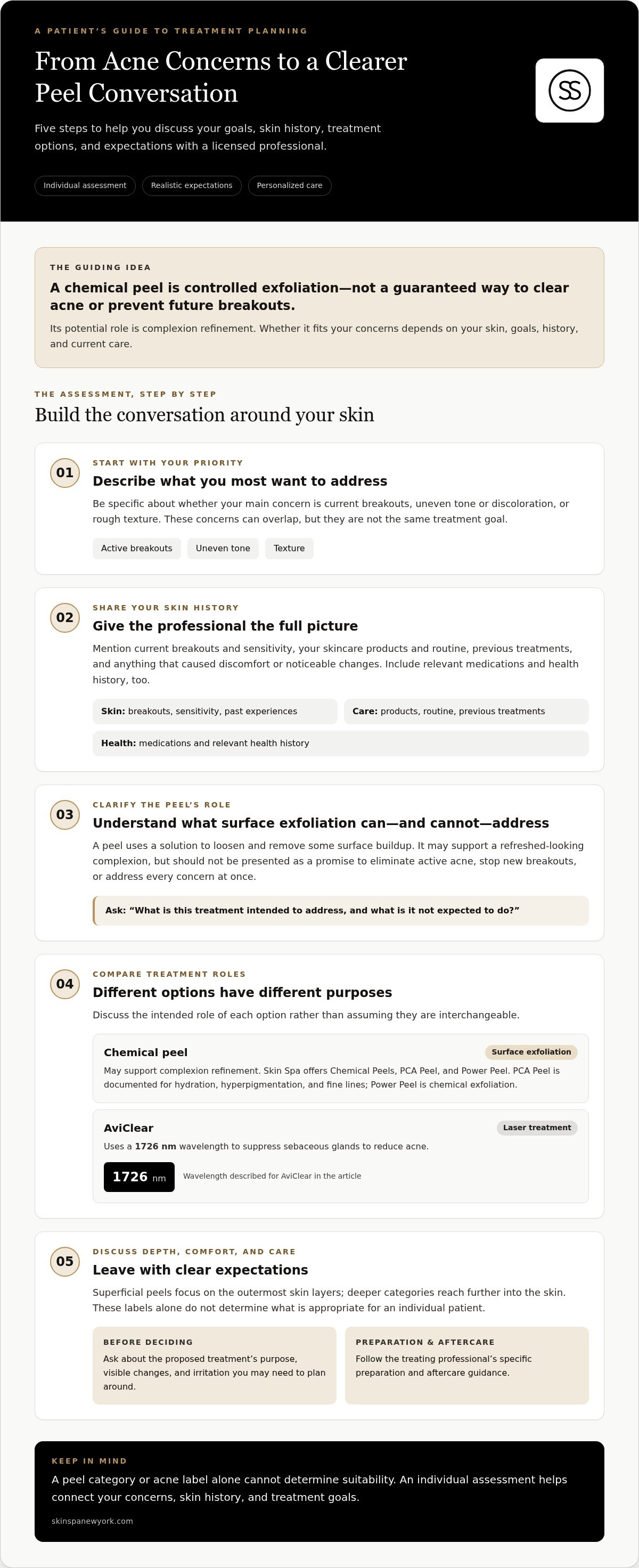
This guide explains what a peel may address, what details to share during an assessment, and what to ask about irritation and aftercare. You’ll also learn how Skin Spa New York’s chemical peel options differ from AviClear, a laser treatment that uses a 1726 nm wavelength to suppress sebaceous glands to reduce acne. The goal is to help you have a focused, informed conversation about your options.
Key Takeaways
- Whether to consider a chemical peel for acne depends on your skin history, current routine, and treatment goals.
- The peel formulation and approach shape how treatment is used. An assessment helps determine whether it aligns with your concerns.
- Chemical peels, topical skincare discussions, and AviClear have different roles and shouldn’t be treated as interchangeable options.
- Share your medications, skincare products, and past skin experiences. Follow the treating professional’s specific preparation and aftercare guidance.
- Skin Spa offers Chemical Peels, PCA Peel, and Power Peel. PCA Peel is documented for hydration, hyperpigmentation, and fine lines, while Power Peel is chemical exfoliation.
Chemical Peels for Acne in NYC: What They Can, and Cannot, Address
If breakouts, lingering marks, uneven tone, or rough texture are all on your mind, it helps to clarify what a peel is intended to address. A chemical peel is controlled exfoliation: a solution encourages the shedding of surface skin layers to reveal a refreshed-looking surface. It may support complexion refinement, but it shouldn’t be presented as a guaranteed way to clear acne or prevent future breakouts.
A chemical peel is a skin-exfoliation treatment selected according to an individual assessment, not a universal solution for acne. That distinction matters when you’re considering a chemical peel for acne in NYC. Acne-prone skin may be one concern to discuss, while the goal of a peel may be texture or a more even-looking tone. Those aims can overlap, but they are not the same as treating the causes of active acne.
What a chemical peel does at the skin surface
During a peel, exfoliating ingredients act on the skin’s surface to loosen and remove some surface buildup. This differs from physically scrubbing the skin. The word “peel” can suggest dramatic shedding, but the experience and visible effects depend on the treatment selected and the individual. This chemical peel overview describes common categories and how they work.
Broadly, superficial peels focus on the outermost skin layers, while deeper categories reach further into the skin and involve a different level of treatment. These labels alone don’t determine what’s appropriate for a particular patient. A professional evaluation can consider your skin condition, history, goals, and expectations.
Why acne concerns call for realistic expectations
Acne can look and behave differently from patient to patient. Some people are mainly concerned about current breakouts; others focus on uneven tone or texture left behind. A peel’s complexion-refining role should be distinguished from a promise to eliminate active acne, stop new breakouts, or address every concern at once. It may be considered as part of a broader conversation, but its role depends on an individual assessment.
Before choosing a treatment, describe what you’re seeing and what you hope to change. Explain whether your priority is the appearance of the skin’s surface, discoloration, or ongoing breakouts. Mention sensitivity and your current skincare routine, too. These details help clarify whether a peel aligns with your goal or whether another acne-focused approach deserves discussion.
Ask what the proposed treatment is intended to address, what it isn’t expected to do, and what visible changes or irritation you may need to plan around. Clear answers help you weigh a peel against your routine and comfort level. The discussion should leave you with an individualized understanding of the option, rather than an assumption that acne-prone skin automatically makes a peel suitable.
How Chemical Peels Work, and What Shapes an Acne-Focused Plan
A peel isn’t defined by its name alone. Its formulation and the way it’s used help shape the treatment, so choosing an option based only on a symptom or online description can miss important context. For a patient considering a chemical peel for acne in NYC, the first step is an individual assessment, not a guess about which peel or ingredient “matches” a breakout.
What a professional assessment should cover
A useful conversation starts with the full picture of your skin and care routine. Describe what you’re experiencing, including current breakouts and sensitivity, and explain what you’d most like to address. Share previous treatments and the skincare products you use, including anything that has caused discomfort or noticeable changes. This context helps the treating professional understand your starting point.
Also mention relevant medications and health history. Don’t leave out details because they seem unrelated to your skin concern. The assessment should clarify whether a peel is appropriate to discuss or whether another approach better fits your needs. It should also give you space to raise practical concerns, such as irritation or how treatment could fit around your usual routine.
The treatment plan should follow an individual skin assessment, not a peel category or acne label alone. An article can’t determine a particular patient’s suitability. A professional can consider the information you share, explain the purpose of a proposed approach, and answer questions before you decide how to proceed.
How peel categories relate to treatment planning
Superficial, medium, and deep are broad categories describing differences in how a peel works on the skin. They aren’t a self-selection guide. The category, formulation, and treatment approach all matter. Don’t choose a depth or ingredient based only on the appearance of a breakout or skin mark. The Mayo Clinic chemical peel information offers general background on peel depth and topics patients may discuss before and after a procedure.
For acne-focused planning, connect your specific goal with the treatment’s intended role. A patient concerned about active breakouts may have different priorities from someone focused on uneven tone or texture. That distinction helps make the assessment more precise and expectations clearer, but it doesn’t establish which option is suitable. Skin Spa offers chemical peels and skincare treatments to discuss as you consider which questions to bring to a personalized conversation.
Formulation and technique should be explained in terms you understand, without implying that one approach suits every acne concern. If a recommendation isn’t clear, ask what it’s intended to address, what limitations to keep in mind, and how it relates to the goals you shared. A considered plan makes room for those answers before treatment begins.
Chemical Peel or Another Acne Treatment? Compare the Role, Not Just the Name
Acne care can involve different approaches, and the names alone don’t explain what each is intended to do. A chemical peel focuses on exfoliation at the skin’s surface; AviClear has a distinct, documented mechanism. Topical skincare is another part of the conversation, where products and their use can be reviewed in light of your routine and goals. These options have different roles, and none is automatically right for every patient.
A peel exfoliates the skin’s surface, while AviClear uses a 1726 nm wavelength to suppress sebaceous glands to reduce acne. The comparison below describes their different roles, not a ranking.
| Approach | Role in the discussion |
|---|---|
| Chemical peel | Controlled exfoliation may be discussed in relation to complexion goals and an individual assessment. |
| Topical skincare discussion | Review your current products and routine, along with questions about how skincare fits your goals. |
| AviClear | A laser that uses a 1726 nm wavelength to suppress sebaceous glands to reduce acne. Skin Spa notes that results are noticeable after 6 months; this is not a guarantee for an individual patient. |
When a chemical peel may enter the conversation
A peel may be worth discussing if you want to explore surface exfoliation alongside concerns such as texture or uneven-looking tone. That doesn’t mean it replaces medical acne care or suits every acne presentation. The treating professional considers your skin, history, current routine, and priorities before recommending a course of action.
If you’re exploring a chemical peel for acne in NYC, ask what concern a proposed option is meant to address rather than simply which treatment is “best.” Depending on your circumstances, a professional may recommend a different path or discuss how a peel fits with other care. Skin Spa’s chemical peel and skincare options provide context for exploring treatment categories, while an assessment relates those options to your needs.
How AviClear differs from a chemical peel
AviClear and a peel work differently, so comparing them by name alone can be misleading. AviClear uses a 1726 nm wavelength to suppress sebaceous glands to reduce acne. Skin Spa notes that results are noticeable after 6 months, but individual outcomes aren’t guaranteed. A peel, by contrast, is an exfoliation treatment. One approach shouldn’t be assumed to deliver the same effect as the other.
During an assessment, describe whether your main concern is active acne, surface texture, uneven tone, or a combination. Ask what the recommended approach is designed to address and how it relates to your goals. That discussion can help you understand your options without treating a peel and AviClear as substitutes or assuming that a particular treatment is suitable based on symptoms alone.
Preparing for a Chemical Peel: Questions, Skin History, and Aftercare
Good preparation begins with a clear conversation, not a routine copied from a general online guide. If you’re considering a chemical peel for acne in NYC, share details about your skin and current care so your treating professional can understand your concerns and explain the preparation and aftercare for your plan. Ask questions before treatment so you know what to expect and can make an informed decision.
What to discuss before treatment
Use this checklist to organize the conversation. You don’t need to diagnose your skin or decide which peel is right. Your role is to provide a clear picture of your experience and goals.
- Describe your current concerns. Explain where and how you’re experiencing breakouts, and mention skin sensitivity, irritation, or changes you’ve noticed.
- Share your skin history. Discuss previous peels or other skin treatments, including how your skin responded and any reactions that concerned you.
- List your routine and medications. Tell the professional about the skincare products you use at home and any relevant medications. Include products or treatments you’ve recently added or changed.
- Clarify your goals and practical questions. Say what you hope to address, then ask what sensations or visible changes may apply, whether follow-up is expected, and what instructions you’ll need to follow.
These details give the treating professional context to assess your circumstances and determine whether a peel or another approach is appropriate. If you’re unsure whether a product or medication is relevant, mention it. The professional can review the information and explain how it affects the treatment discussion.
Following individualized aftercare
Aftercare depends on the treatment selected and your skin. A general online routine can’t account for every formulation, approach, or individual response. Before treatment, ask for clear pre- and post-treatment instructions specific to your plan, including guidance on skincare and what to do if you have questions afterward.
Follow those instructions rather than adding generic advice from other sources or changing your routine based on assumptions. If anything is unclear, ask your treating professional to clarify it. Contact the treating practice about an unexpected or concerning reaction so they can advise you based on the treatment you received. This is especially helpful if you’re unsure whether a change is expected or needs attention.
Taking time to prepare can make the experience feel more considered and help you understand the plan before it begins. For a personalized discussion of your skin treatment options, explore personalized skin treatments.
Chemical Peels for Acne at Skin Spa in NYC: Next Steps
Considering a peel is an opportunity to clarify what you want from treatment and which options make sense to discuss. Skin Spa offers Chemical Peels, PCA Peel, and Power Peel. Each has a distinct documented role, and none should be assumed to address active acne or suit every patient. For patients considering a chemical peel for acne in NYC, a focused conversation can help distinguish complexion goals from acne-focused concerns.
Skin Spa peel options and personalized care
Skin Spa’s PCA Peel is documented for hydration, hyperpigmentation, and fine lines. It shouldn’t be described as an acne-specific treatment. Power Peel is chemical exfoliation; its name alone doesn’t establish a particular ingredient, strength, or outcome. Chemical Peels are another option to discuss during an individual assessment, where the professional can explain the purpose of the approach being considered.
Skin Spa’s client-right-to-know policy advises each patient on the products and techniques best suited to maximize the benefits of their service. Ask what an option is designed to address and how it relates to your goals. If your priority is active breakouts, say so clearly. If you’re also concerned about uneven-looking tone or texture, include that in the discussion. Being specific keeps the conversation centered on your needs without suggesting that a peel is a guaranteed acne solution.
What to expect from the first conversation
Start by describing what you’re experiencing now, what you’ve tried, and the kind of treatment experience you’re comfortable with. You may be concerned about sensitivity, visible peeling, or how treatment could fit into everyday plans. Share your skincare routine and relevant skin history, too. This context helps the treating professional discuss options based on your circumstances, rather than making assumptions from a treatment name alone.
Bring questions about what a recommended peel is intended to address, what it may not address, and what preparation or aftercare instructions apply. If the proposed option doesn’t align with your goals or comfort level, say so. You should leave the discussion with a clearer understanding of the recommendation and its limits, not pressure to choose a treatment.
Skin Spa serves patients in New York, Boston, and Miami. You don’t need to arrive having chosen a specific peel. Explore Skin Spa treatment options and consider which questions you’d like to bring to a personalized discussion.
Take the Next Step with Confidence
Deciding whether a chemical peel for acne in NYC is right for you can begin with a simple goal: leave the conversation understanding why an approach is being considered and what it is intended to address. You don’t need to arrive with a treatment already selected. Your questions, comfort level, and priorities all matter.
Give yourself time to ask for clarity. A good next step is one that feels informed and aligned with your individual needs, rather than driven by pressure or the promise of a particular result. Use what you’ve learned to start a conversation that reflects your skin concerns and the experience you’re looking for.
Skin Spa helps patients understand treatment options and the techniques involved. If you’re ready to discuss your goals and explore available peel options in New York, Boston, or Miami, explore personalized skin treatments at Skin Spa.
Frequently Asked Questions
Is a chemical peel good for acne?
It may be considered in some acne-related care, but it isn’t automatically right for every patient. Before proceeding, clarify what improvement you’re hoping to see and how the professional will assess whether the treatment is meeting that goal. If your main concern is persistent breakouts rather than the look of your skin’s surface, make that distinction explicit so the discussion stays focused on your priority.
Can a chemical peel make acne worse?
Skin irritation is possible, and an individual response can’t be predicted from the treatment name alone. If your skin is unusually sore or irritated close to your appointment, let the treating practice know before treatment rather than trying to manage the change on your own. Ask what reactions would be expected for your plan and which changes should prompt you to seek guidance.
How many chemical peels are needed for acne?
There’s no set number that can be promised for acne concerns. The number, if any, depends on the treatment plan and how your skin responds. Be cautious about assuming that a fixed series is necessary before your skin has been assessed. Ask what would guide the decision to recommend another treatment, and how your progress will be considered alongside your original goal.
What happens if I have active acne before a chemical peel?
Active acne doesn’t automatically tell you whether to proceed or cancel. If a breakout appears or changes after your consultation, share that update with the treating practice before treatment so the professional can advise you based on your current skin. Avoid trying a new product or at-home exfoliation to “prepare” the area unless your treating professional has specifically included it in your instructions.
Does a chemical peel hurt, and will my skin visibly peel?
The sensation and visible effects aren’t identical for every treatment or patient. Ask the professional to describe what the selected plan may feel like during application and what you might see afterward. If you’re planning around a work presentation, photograph, or social occasion, mention the date. That gives the professional useful context when discussing whether the timing feels appropriate for you.
Is AviClear the same as a chemical peel for acne?
No. They’re distinct treatment options, so the name of one shouldn’t lead you to assume it offers the same experience or addresses the same goal as the other. If both come up in your care discussion, ask why each is being considered for your concern and what differences matter for your decision. That can help you compare options without treating them as interchangeable.
Can I use my regular skincare products after a chemical peel?
Don’t assume every product in your routine can be used immediately afterward. Keep the packaging or ingredient lists for products you use regularly, including prescription skincare, so you can get clear guidance about each one. Follow the instructions for your specific treatment before restarting products, and avoid adding new exfoliating products on your own while your skin is adjusting.
