

What if the key to erasing years of sun damage isn't found in a heavier concealer, but in a controlled, medical-grade renewal? You've likely spent months trying to mask stubborn dark spots that simply refuse to fade. It's common to feel a sense of hesitation when considering a chemical peel for hyperpigmentation, especially when the fear of damaging your skin further keeps you from seeking professional help. We understand that the variety of acids and strengths can feel overwhelming, leaving you unsure of which path leads to genuine, safe results.
This guide demystifies the process of professional exfoliation, showing you how sophisticated formulas like PCA Peels target melanin at the source. You'll discover how medical-grade treatments reveal a refined, even-toned complexion while adhering to the rigorous safety standards established by the 2026 MoCRA regulations. We'll explore the science behind acid selection, the necessity of expert supervision to avoid injury, and how to build a clear plan for visible, long-term skin maintenance. It's time to move beyond temporary fixes and embrace a professional strategy for lasting radiance.
Key Takeaways
- Learn how professional exfoliation accelerates cell turnover to lift stubborn melanin and reveal a more luminous, even-toned surface.
- Discover why a chemical peel for hyperpigmentation, particularly medical-grade PCA Peels, offers a superior approach to targeting both sun damage and melasma.
- Gain confidence in treatment safety by understanding how the Fitzpatrick scale guides acid selection for every unique skin tone.
- Prepare for your transformation with a detailed look at the essential "priming" phase and the sensory experience of a professional-grade treatment.
- See how personalized, multi-modality plans at Skin Spa New York provide the framework for long-term skin health and maintenance.
Understanding Hyperpigmentation and the Role of Chemical Exfoliation
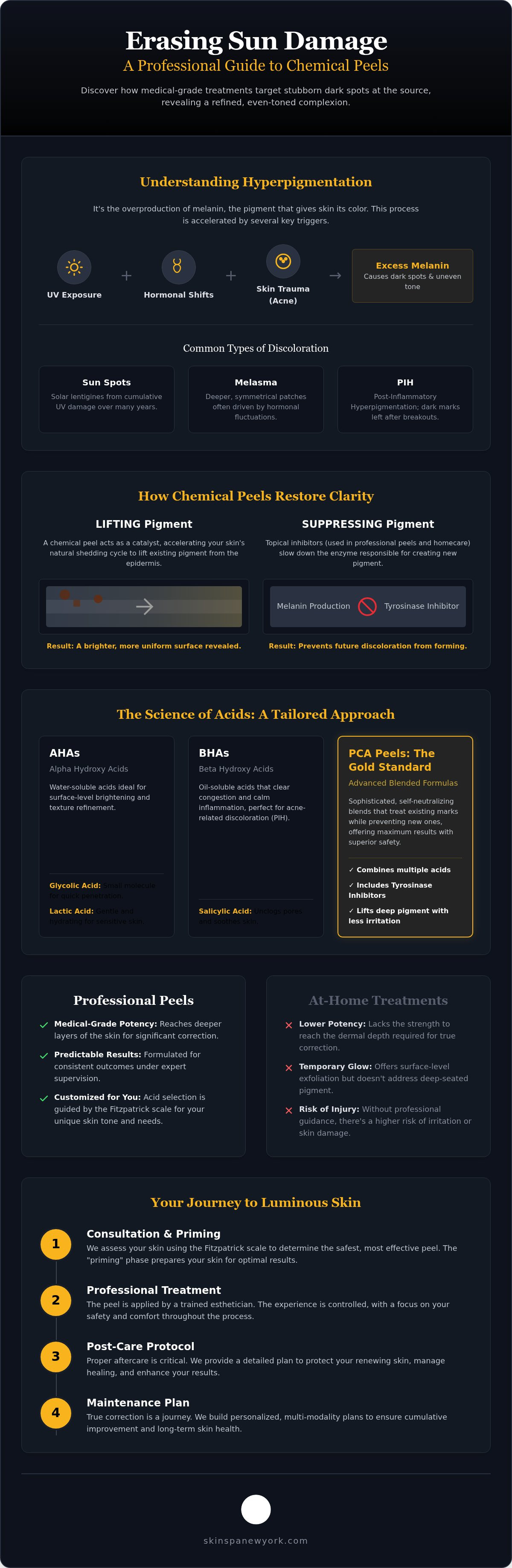
Hyperpigmentation is more than just a surface concern; it's a biological response to internal and external stressors. At its core, it's the overproduction of melanin, the pigment that gives our skin its color. This excess is often triggered by prolonged UV exposure, hormonal shifts, or physical trauma to the skin, such as acne. While your skin naturally sheds dead cells, this process slows down as we age or face environmental challenges. A chemical peel for hyperpigmentation acts as a professional catalyst, accelerating this natural cycle to reveal the brighter, more uniform skin beneath.
It's vital to understand that a Chemical peel works by "lifting" existing pigment that has already settled in the upper layers of the epidermis. This is distinct from "suppressing" melanin, which involves using topical inhibitors to prevent future discoloration. Most guests come to us with one of three common concerns:
- Sun spots (solar lentigines) from cumulative UV damage over years of exposure.
- Melasma, which is often deeper and driven by hormonal fluctuations, appearing as symmetrical patches.
- Post-inflammatory hyperpigmentation (PIH), the lingering dark marks left behind after a breakout or injury.
Why Urban Skin Needs Professional Intervention
Living in a fast-paced metropolitan environment like NYC, Boston, or Miami introduces unique stressors. City pollution generates free radicals that cause oxidative stress, which directly fuels the formation of dark spots and dullness. While at-home treatments might offer a temporary glow, they often lack the potency to reach the dermal depth required for significant correction. Professional-grade acids are essential for achieving consistent, predictable results that address the specific needs of urban residents who face daily environmental aggression. At-home versions simply don't provide the same level of precision or safety.
The Emotional Journey to Clear Skin
Persistent discoloration can be incredibly frustrating, often feeling like a barrier between you and the world. We see many clients who are tired of relying on heavy foundations to feel "presentable" or confident. There is a profound boost associated with a refined, even skin tone that looks just as good in natural light as it does in a mirror. Setting realistic expectations is part of our professional care. While a single chemical peel for hyperpigmentation provides visible renewal, true correction is a journey of cumulative improvement and professional guidance.
The Science of Peels: AHA, BHA, and the PCA Advantage
Selecting the right chemical peel for hyperpigmentation requires a deep understanding of molecular behavior. Acids aren't simply "strong" or "weak"; they're tools designed to interact with specific layers of the skin. Alpha Hydroxy Acids (AHAs), such as Glycolic and Lactic acid, are the standard for surface-level brightening. Glycolic acid penetrates quickly due to its small molecular size, while Lactic acid offers a more hydrated, gentle approach for sensitive complexions. For those dealing with acne-related discoloration, Beta Hydroxy Acids (BHAs) like Salicylic acid are indispensable. They're oil-soluble, allowing them to clear congestion while calming the inflammation that often leads to dark spots.
Modern aesthetic science has moved beyond single-acid solutions toward "blended peels." These formulations combine multiple active ingredients to address several concerns at once. A critical component of these professional formulas is the inclusion of tyrosinase inhibitors. Ingredients like Kojic acid or Hydroquinone don't just exfoliate; they actively slow down the enzyme responsible for pigment production. This dual-action approach ensures you're treating existing marks while preventing new ones from forming during the renewal process.
The PCA Peel: A Gold Standard for Pigmentation
PCA Peels represent a significant advancement in corrective skincare, particularly for those struggling with stubborn melasma. Unlike traditional formulas that require aggressive neutralization, many PCA options are self-neutralizing. This allows for unmatched precision and safety, as the solution naturally stops its activity once it reaches the target depth. These blends often incorporate powerful skin-brightening agents that work synergistically to lift deep-seated pigment without the excessive irritation often associated with high-strength treatments. If you're looking for a tailored approach, exploring our customized PCA Peels can provide the results your skin deserves.
Superficial vs. Medium-Depth Peels
The choice between a superficial and a medium-depth chemical peel for hyperpigmentation depends on your lifestyle and the severity of your discoloration. A light "lunchtime" peel focuses on the epidermis, offering an instant glow with minimal downtime. In contrast, medium-depth treatments often utilize Trichloroacetic Acid (TCA) to reach deeper pigment layers. While TCA delivers more dramatic clinical results, it also involves a more intensive risks and healing process that requires careful professional oversight. Your specialist will help you balance the desire for rapid transformation with the practicalities of your recovery time.
Choosing the Right Peel for Your Fitzpatrick Skin Type
Safety is the cornerstone of every aesthetic journey, and in the world of professional resurfacing, the Fitzpatrick scale is our primary compass. This classification system doesn't just categorize your skin tone; it predicts how your melanocytes will react to heat, light, and chemical triggers. For many, the most pressing question is whether a chemical peel for hyperpigmentation is safe for deeper complexions. The answer is a definitive yes, provided the treatment is administered with clinical precision and a deep understanding of ethnic skin needs. We don't believe in a one-size-fits-all approach; we believe in a safe-for-all approach.
Using a formula that's too aggressive for your specific type can lead to a defensive reaction known as post-inflammatory hyperpigmentation. Instead of clearing dark spots, the skin produces even more melanin as a response to perceived trauma. This is why we emphasize the "priming" phase. By using melanin-suppressing topicals for at least two weeks before your appointment, we stabilize the skin's pigment-producing cells. This preparation ensures a predictable outcome and allows the peel to work efficiently without triggering the skin's natural defense mechanisms.
Safety Protocols for Fitzpatrick IV-VI
For those with richer skin tones, we often favor Lactic and Mandelic acids. Mandelic acid, in particular, has a larger molecular size, which means it penetrates the skin more slowly and evenly than glycolic acid. This "low-and-slow" treatment progression is vital for preventing irritation that could lead to rebound pigment. We recommend starting with gentler concentrations and gradually increasing the intensity as your skin builds tolerance. You can explore our Fitzpatrick Skin Type guide to better understand how your specific profile influences treatment selection.
Customizing the Approach for Sensitive Skin
Treating hyperpigmentation in sensitive skin requires a delicate balance between effective exfoliation and barrier repair. During a chemical peel for hyperpigmentation, our expert estheticians closely monitor the skin for "frosting," a clinical sign where certain areas turn white, indicating the acid has reached a specific depth. For sensitive guests, we prioritize self-neutralizing formulas and follow the procedure with soothing, lipid-rich topicals. This ensures that while we're lifting dark spots, we're also reinforcing the skin's natural moisture barrier, leaving you with a complexion that feels as healthy as it looks.
The Treatment Journey: Preparation, Frequency, and Post-Care
Achieving the most refined results from a chemical peel for hyperpigmentation begins long before you step into our sanctuary. We prioritize a "priming" phase. This requires using specific brightening agents for at least two weeks prior to your appointment. By stabilizing your melanocytes, we reduce the risk of reactive darkening and ensure the acid penetrates evenly. It's a proactive step that transforms a standard procedure into a personalized clinical success. This preparation is especially vital for those with deeper skin tones where pigment cells are more reactive.
During the treatment, you'll feel the formula working. It's usually described as a warm tingling or a spirited prickle rather than an uncomfortable burn. Our specialists remain by your side, monitoring your skin's reaction with professional precision. Once the physical renewal starts, typically between days three and five, you'll see light flaking. This is the visible evidence of the pigment lifting away. In high-exposure cities like Miami, NYC, or Boston, your post-care must center on protection. SPF 30 or higher is a strict, non-negotiable requirement. Urban environments reflect significant UV radiation off glass and pavement; your newly revealed skin is temporarily more vulnerable to sun damage.
How Many Peels Do You Actually Need?
Hyperpigmentation is often deep-seated, meaning it rarely resolves in a single session. Most guests see the most dramatic transformation after a series of 3 to 6 treatments. We space these sessions approximately four weeks apart. This rhythm respects your skin's natural renewal cycle while building cumulative results. Once you achieve your desired tone, a maintenance strategy involving quarterly peels and medical-grade topicals will keep dark spots from returning. To start your customized journey, you can book your initial consultation at any of our urban locations.
Post-Peel Dos and Don'ts
The most important rule of recovery is simple: never pick at peeling skin. Forcing the exfoliation process can lead to scarring or new discoloration. Stick to gentle, non-foaming cleansers and lipid-rich hydrators that support the skin's barrier during this delicate time. You should pause your normal retinol or vitamin C routine for about seven days. Once the flaking has completely subsided and your skin feels resilient, you can gradually reintroduce these active ingredients to enhance your long-term results. Consistency in this recovery phase is what separates a good result from a professional-grade transformation.
Synergistic Solutions at Skin Spa New York
At Skin Spa New York, we recognize that achieving a truly luminous complexion often requires more than a single modality. We position ourselves as a premier authority in creating customized, multi-modality plans that address the complexities of your skin. A chemical peel for hyperpigmentation serves as a powerful catalyst within these plans. By expertly removing the barrier of dull, damaged cells, a peel significantly enhances the absorption and efficacy of medical-grade topicals. This ensures that the active ingredients in your home-care regimen can penetrate deeper and work more efficiently. We often suggest a Customized Facial as a foundational step, allowing our specialists to stabilize your skin's health before advancing to more intensive corrective treatments.
Our approach is rooted in the belief that your skin deserves a strategy as unique as your lifestyle. Whether you are navigating the high-energy streets of Manhattan, the historic charm of Boston, or the vibrant sun of Miami, our expert guides are here to help. We invite you to schedule a professional consultation to discuss how a tailored chemical peel for hyperpigmentation can be integrated into a comprehensive plan for your specific goals. This personalized attention ensures that every treatment moves you closer to the polished, even-toned results you desire.
Peels + Lumecca IPL: The Ultimate Brightening Duo
For those seeking the most rapid transformation, we often recommend the synergistic pairing of chemical resurfacing with Lumecca IPL. While a professional peel lifts surface-level pigment and smoothes texture, Lumecca IPL utilizes intense pulsed light to target deeper vascular redness and stubborn sun damage. The timing of these treatments is essential for safety and efficacy; we typically recommend spacing them two to four weeks apart to allow the skin to fully recover between sessions. This combination is widely considered the fastest route to achieving a "glass skin" finish, as it addresses discoloration at multiple depths simultaneously.
Laser Genesis and Peels for Texture and Tone
If your concerns include both pigmentation and the early signs of aging, combining Laser Genesis with our specialized peels offers a sophisticated solution. Laser Genesis uses gentle micro-pulses of laser energy to stimulate collagen production and refine the skin's surface from within. When used alongside chemical resurfacing, this duo provides a comprehensive approach to anti-aging. You'll notice an improvement in both the structural integrity of your skin and the clarity of your complexion. Consistent, clinical-grade care is the hallmark of our practice, ensuring that your journey toward radiant skin is both effective and restorative.
Elevate Your Skin Strategy for Lasting Radiance
The journey toward an even-toned complexion is built on a foundation of clinical precision and personalized care. You've discovered how a professional chemical peel for hyperpigmentation does more than surface-level exfoliation; it actively targets deep-seated melanin while preparing your skin for advanced synergistic treatments. By prioritizing expert Fitzpatrick skin typing and medical-grade PCA Peels, you ensure that your transformation is both safe and remarkably effective. Our PCA certified professionals are dedicated to guiding you through every phase of this renewal, from the initial priming to long-term maintenance.
With convenient locations across NYC, Boston, and Miami, your sanctuary for skin health is always within reach. We invite you to step into a space where modern elegance meets professional expertise. Book Your Customized Chemical Peel Consultation and take the first step toward a sophisticated, radiant glow. You've waited long enough for a complexion that reflects your inner confidence; it's time to embrace the clear, resilient skin you deserve.
Frequently Asked Questions
How many chemical peels are needed for hyperpigmentation?
Most guests achieve their desired results after a series of 3 to 6 treatments. These sessions are typically spaced four weeks apart to align with your skin's natural renewal cycle. While a single chemical peel for hyperpigmentation provides an immediate glow, deeper discoloration requires a cumulative approach to lift pigment layers effectively and ensure long-term clarity.
Will a chemical peel make my hyperpigmentation worse?
A professional treatment won't darken your skin when administered with proper skin typing and preparation. The risk of rebound darkening, or post-inflammatory hyperpigmentation, usually occurs when a peel is too aggressive for your Fitzpatrick type or if the skin hasn't been properly primed. Our specialists focus on stabilizing your melanocytes before treatment to ensure a safe, predictable outcome.
Is there a specific chemical peel for melasma?
PCA Peels are widely considered the premier choice for managing stubborn melasma. These professional formulas often incorporate self-neutralizing acids and tyrosinase inhibitors that specifically target the hormonal triggers of pigment production. Because melasma is often deep-seated, these specialized blends allow for precise correction without the excessive heat or irritation that can sometimes trigger further discoloration.
What is the best chemical peel for dark skin with hyperpigmentation?
Mandelic and Lactic acid peels are the most effective and safest options for deeper skin tones. These acids have larger molecular structures, which means they penetrate the skin more slowly and evenly than glycolic acid. This "low-and-slow" approach is vital for Fitzpatrick types IV-VI, as it minimizes the inflammatory response that could otherwise lead to unwanted pigment changes.
How long does it take to see results from a peel?
Initial surface brightening is usually visible within 7 to 10 days once the light flaking phase is complete. However, the correction of deeper sun damage or melasma is a gradual process that unfolds over several months. You'll notice a significant improvement in both texture and tone as you progress through your customized series of treatments and maintain a professional home-care regimen.
Can I get a chemical peel in the summer in Miami or NYC?
You can certainly receive a chemical peel for hyperpigmentation during the summer, provided you're committed to strict sun protection. In high-exposure cities like Miami or NYC, we often recommend lighter "lunchtime" peels during the sunnier months. These treatments provide results with less downtime, making it easier to protect your newly revealed skin from the intense urban UV reflection.
Does a chemical peel for hyperpigmentation hurt?
Most guests describe the sensation as a warm tingling or a spirited prickle rather than actual pain. It's a temporary feeling that lasts only as long as the acid is active on the skin. Our estheticians use cooling fans and soothing post-treatment topicals to ensure you remain comfortable throughout the process, leaving you feeling refreshed rather than distressed.
What is the difference between a spa peel and a medical-grade PCA peel?
The primary difference lies in the potency and the sophistication of the delivery system. While a traditional spa peel focuses on surface-level exfoliation, a medical-grade PCA peel utilizes higher concentrations of active acids and specific inhibitors to reach deeper layers. These professional formulas are designed for clinical correction, offering a level of precision and result-oriented care that standard over-the-counter options cannot match.
