

What if your luxury moisturizer is merely masking a structural failure in your skin's defense system rather than actually repairing it? You've likely felt that persistent tightness after a morning cleanse or noticed visible flaking under your foundation by midday. It's frustrating to invest in high-end products only to have seasonal changes trigger that familiar, uncomfortable itchiness. With 91% of people in urban areas breathing polluted air according to the World Health Organization, your dry skin is likely battling more than just a lack of water; it's struggling against a compromised barrier.
We're here to help you move beyond surface-level hydration and master the science of restoration with an expert-led clinical checklist. You'll gain a clear understanding of your specific skin type and learn how to build a repeatable routine that actually works. This guide provides expert guidance on professional interventions, such as Laser Genesis or a Customized Facial, ensuring you move from temporary relief toward clinical-grade transformation and lasting comfort.
Key Takeaways
- Identify the critical distinction between lipid depletion and simple dehydration to ensure you are addressing the root cause of your dry skin.
- Audit your current regimen for "moisture leaks" caused by high-pH cleansers and aggressive exfoliation techniques that compromise your natural barrier.
- Understand the clinical advantage of medical-grade formulations and professional interventions, such as a Customized Facial, in achieving deeper restorative results.
- Master a sophisticated daily protocol that layers humectants for daytime protection and replaces vital lipids for intensive overnight repair.
Understanding Dry Skin: Symptoms, Causes, and Urban Stressors
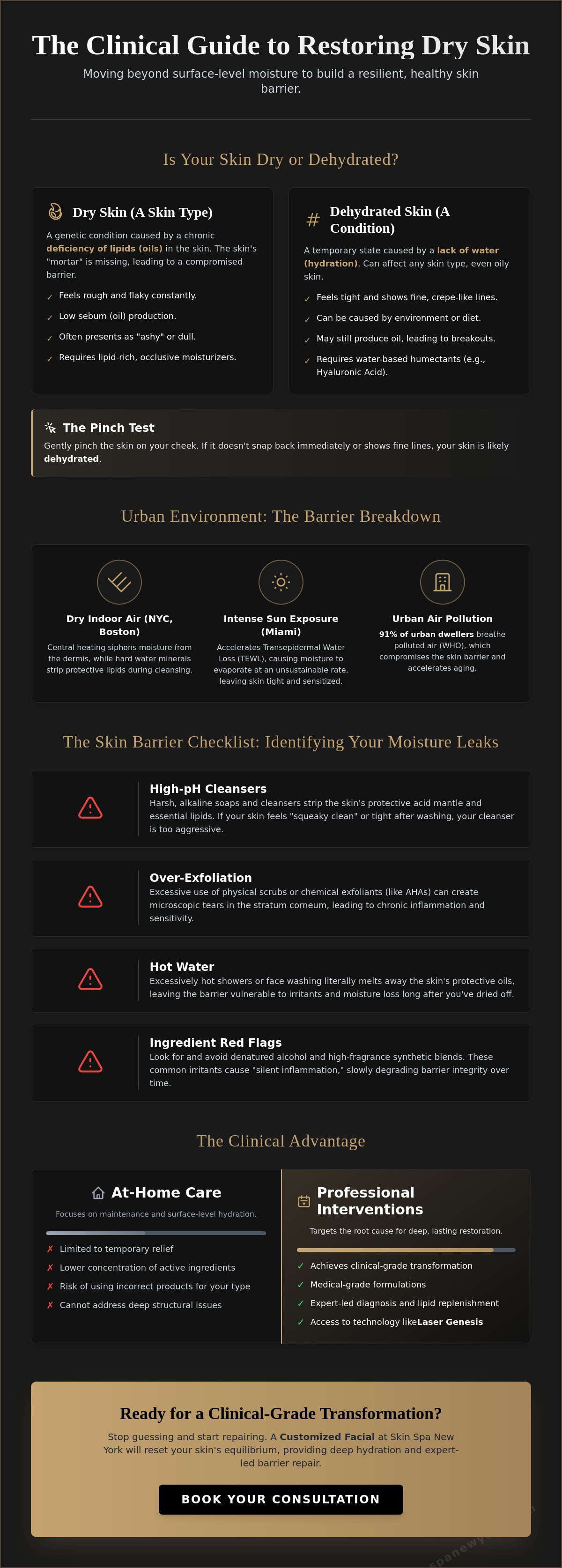
Clinical dermatology defines dry skin, or xerosis, as a physiological deficiency of lipids within the stratum corneum. Unlike a temporary lack of moisture, this condition stems from a shortage of the essential oils that bind skin cells together. When these "cellular mortar" lipids are absent, the skin loses its ability to retain hydration, leading to what professionals call the "Dry Riverbed" effect. Much like a parched landscape, the skin surface develops microscopic fissures and cracks that signal a fundamentally compromised barrier. For those with deeper skin tones, this often manifests as a persistent "ashy" appearance; a gray or dull cast that remains even after applying standard lotions. Understanding Dry Skin requires looking past the surface to address these underlying structural gaps.
Dry vs. Dehydrated: Why the Distinction Matters
It's vital to recognize that dry skin is a genetic skin type characterized by low sebum production, while dehydration is a fleeting condition caused by a lack of water. If you treat dehydrated skin with heavy, occlusive oils, you often end up with congestion and breakouts without actually solving the thirst of the cells. You can perform a simple "pinch test" at home to determine your status. Gently pinch a small area of skin on your cheek or the back of your hand; if it doesn't immediately snap back or shows fine, crepe-like lines, you're likely dealing with dehydration rather than a true dry skin type.
The Urban Environment: NYC, Boston, and Miami Factors
Living in a major metropolitan area introduces specific stressors that exacerbate barrier dysfunction. In cities like NYC and Boston, the aggressive central heating used during the winter months acts as a vacuum, siphoning moisture directly from the dermis. This is often compounded by the high mineral content in metropolitan hard water, which can disrupt the skin's naturally acidic pH and strip away protective lipids during every shower. Meanwhile, in Miami, intense sun exposure accelerates Transepidermal Water Loss (TEWL). This process forces moisture to evaporate through the skin barrier at an unsustainable rate, leaving the complexion feeling tight and sensitized despite the high humidity. Identifying these environmental triggers is the first step toward a customized clinical solution.
The Skin Barrier Checklist: Identifying Your Moisture Leaks
Restoring your complexion starts with a rigorous audit of your daily habits. Identifying where your moisture is escaping allows you to transition from reactive care to proactive barrier maintenance. Start by examining your cleanser; many traditional soaps possess a high pH that strips away the very lipids your dry skin desperately needs to retain. If your skin feels tight or "squeaky clean" after washing, you've likely disrupted the acid mantle. Next, evaluate your exfoliation frequency. While Alpha Hydroxy Acids (AHAs) provide a radiant glow, over-use can create microscopic tears in the stratum corneum, leading to chronic sensitivity. You can reference The Ultimate Hydration Checklist to see how your current environment, particularly indoor humidity levels below 30%, might be contributing to your discomfort.
Biological and Lifestyle Triggers
Internal factors often dictate how your skin responds to external stressors. Aging naturally reduces the production of sebum and ceramides, the essential fats that keep skin supple and resilient. Certain medications, such as statins or diuretics, can also exacerbate systemic dryness by altering the body's lipid balance. Even your morning ritual plays a role; excessively hot water literally melts away the skin’s protective oils, leaving the surface vulnerable to irritants long after you've stepped out of the shower.
The Ingredient Red Flag List
Scrutinize your product labels for denatured alcohol and high-fragrance synthetic blends. These ingredients are common culprits for silent inflammation, which slowly degrades the barrier's integrity over time. During a flare-up, a "less is more" approach is often the most effective path to recovery. Stripping back your routine to basic, clinical-grade essentials prevents further irritation while your cells work to repair themselves. If your dry skin feels persistently compromised despite these changes, a professional Customized Facial can help reset your skin's equilibrium through expert-led lipid replenishment and deep hydration.
By systematically checking these variables, you move beyond guesswork. You begin to treat your skin with the precision it requires, ensuring every product and habit supports the barrier rather than breaking it down. This clinical mindset is what separates a temporary fix from a permanent restoration of your natural glow.
Clinical Comparison: At-Home Care vs. Professional Interventions
Achieving a truly radiant complexion requires moving beyond the aisles of your local pharmacy. While over-the-counter products offer temporary relief, they rarely address the cellular deficiencies associated with chronic dry skin. The primary difference lies in molecular engineering and delivery mechanisms. Medical-grade serums are formulated with smaller molecules designed to bypass the stratum corneum, reaching the deeper dermal layers where true transformation occurs. In contrast, many surface-level creams simply sit on the surface, providing a fleeting sense of comfort without altering the skin's long-term hydration capacity. It's the difference between masking a problem and solving it at the source.
The Limits of Over-the-Counter Hydration
Many consumers fall into the "occlusive trap" by applying thick, heavy salves that essentially suffocate the skin. While these products provide a temporary barrier, they can prevent the skin from performing its natural gas exchange and renewal processes. This reliance on heavy coatings often masks the underlying issue of Transepidermal Water Loss (TEWL). TEWL is the involuntary evaporation of water from the dermis into the atmosphere; it's the silent thief that leaves your skin feeling parched despite your best efforts. Without professional-grade humectants, water continues to escape, regardless of how much cream you apply.
Why Medical-Grade Esthetics Outperform Home Care
Professional treatments at a MedSpa offer a level of precision that home routines simply cannot replicate. For instance, Microneedling uses controlled trauma to stimulate the body's natural healing response, encouraging the production of new collagen and endogenous hyaluronic acid. To ensure these nutrients actually reach their target, chemical peels are utilized to remove the "dead cell dam" of accumulated keratinocytes that often block product absorption. Modern clinical settings also leverage vacuum-infusion technology, which simultaneously exfoliates the surface while forcing potent serums into the skin. This dual-action approach ensures that hydration is not just applied, but deeply integrated into the tissue.
The value of a results-driven clinical treatment also lies in professional diagnostics. An expert esthetician can differentiate between genetic dry skin and environmental sensitization, allowing for a level of customization that a generic "pampering" facial lacks. When you choose a Signature Facial or a specialized Laser Genesis session, you're investing in a sophisticated strategy. These interventions use gentle heat and advanced light therapy to stimulate the skin's internal repair mechanisms, a feat no topical cream can achieve on its own. This shift from aesthetic indulgence to clinical intervention is essential for those seeking a permanent solution to barrier dysfunction.
The Ultimate Hydration Checklist: A Daily and Weekly Protocol
Transitioning from understanding the science to implementing a ritual requires a structured cadence. Your daily habits are the foundation upon which barrier restoration is built. For those managing dry skin, the goal is to shift from sporadic moisture application to a disciplined, clinical-grade protocol that respects the skin’s circadian rhythm. A morning ritual should prioritize environmental defense, while your evening routine focuses on intensive cellular repair and lipid replenishment.
The Layering Strategy: Humectants, Emollients, and Occlusives
Effective hydration is a three-part symphony. You must first apply humectants, like hyaluronic acid or glycerin, which act as water magnets to pull moisture into the cells. Next, emollients such as squalane or ceramides fill the microscopic gaps between skin cells, smoothing the surface and restoring suppleness. Finally, occlusives provide a protective seal to prevent evaporation. Always apply your products from thinnest to thickest, beginning with water-based serums. To maximize absorption, follow the "3-minute rule" by applying your first layer to slightly damp skin immediately after cleansing. This technique is particularly effective for dry skin as it traps existing moisture before it can evaporate.
Your weekly maintenance should move away from the aggressive mechanical scrubbing that often characterizes amateur skincare. Instead, opt for gentle enzymatic exfoliation. Enzymes dissolve the "glue" holding dead cells together without the risk of micro-tears associated with physical beads. This ensures your medical-grade serums can penetrate effectively without compromising the barrier you're working so hard to rebuild.
Environmental and Dietary Support
External products only tell half the story. Maintaining indoor humidity levels between 40% and 60% is essential to prevent the air from siphoning moisture from your face. Internally, focus on Omega-3 fatty acids, which are vital for maintaining the fluidity of your cell membranes. Be mindful of your intake of caffeine and alcohol; both are systemic dehydrators that can leave your complexion looking dull and depleted. If you're ready to elevate your results beyond at-home care, book a Signature Facial to experience professional-grade lipid infusion and personalized barrier support.
Consistency is your most powerful tool. By aligning your lifestyle with these clinical principles, you create an environment where your skin can thrive. This protocol doesn't just treat symptoms; it fosters a resilient, self-sustaining barrier that remains luminous regardless of the season or city stressors.
Professional Clinical Strategies at Skin Spa New York
While a disciplined home routine is essential, professional intervention provides the intensive restoration that topical creams alone cannot achieve. Skin Spa New York serves as a refined sanctuary where clinical expertise meets high-end hospitality. Our approach to treating dry skin is rooted in customization, ensuring that your treatment plan accounts for the specific urban stressors of your environment. Whether you're battling the dry heat of a Manhattan winter or the intense sun exposure in Miami, our estheticians utilize advanced technologies to rebuild your barrier from the inside out.
Advanced Hydration: Oxygeneo and Laser Genesis
We offer sophisticated solutions that go beyond simple moisturizing. Oxygeneo is a transformative "3-in-1" treatment that provides exfoliation, oxygenation, and nutrient infusion in a single session. By creating a CO2-rich environment on the skin's surface, it triggers a biological response that draws oxygen-rich blood to the treated area, significantly improving cellular metabolism. For those seeking structural repair, Laser Genesis utilizes gentle heat to revitalize the upper dermis. This process promotes natural collagen production, which is fundamental to the skin's ability to hold moisture and maintain a resilient barrier. Both treatments offer zero downtime, making them ideal for the busy professional who requires immediate, visible results without a recovery period.
Your Personalized Skin Consultation
Every journey toward restoration begins with a comprehensive diagnostic process. Our expert estheticians perform a detailed analysis to identify specific areas of barrier damage and determine the root cause of your dry skin. This personalized attention ensures that every session, from a Signature Facial to a more intensive MedSpa treatment, is tailored to your unique goals. Following your procedure, we curate a specific home-care regimen to maintain your clinical results and protect your skin against future moisture leaks. It's a holistic partnership designed to restore your confidence and your glow.
Ready to experience professional-grade relief? Book your customized facial at our NYC, Boston, or Miami locations and begin your clinical transition to lasting skin health.
Elevate Your Skin Restoration Strategy
Mastering the science of hydration requires a transition from reactive surface care to a structured, clinical-grade protocol. You've gained the tools to audit your daily environment and recognize the vital distinction between lipid depletion and simple dehydration. By aligning your morning and evening rituals with the specific needs of your barrier, you move closer to a complexion that is resilient, supple, and luminous. It's time to stop guessing and start treating your skin with the precision it deserves.
When at-home care reaches its limit, professional expertise becomes the essential next step for lasting results. Skin Spa New York was founded in 2005 and brings over 20 years of clinical expertise to every guest experience. We utilize advanced medical-grade technology, such as Morpheus8 and Oxygeneo, to revitalize dry skin at a cellular level. With convenient luxury locations across Manhattan, Boston, and Miami, our team provides a reliable sanctuary for those seeking a modern, results-driven approach to self-care.
Schedule Your Customized Skin Consultation Today and discover a personalized path toward transformation. We look forward to welcoming you into our space and helping you achieve the healthy, protected barrier your skin needs to thrive.
Frequently Asked Questions
How can I tell if my skin is dry or just dehydrated?
Dry skin is a genetic type characterized by a chronic lack of oil, while dehydration is a temporary condition caused by a lack of water. If your complexion feels rough and lacks visible pores, you likely have a dry skin type. In contrast, dehydrated skin often looks dull and shows fine, "crepe-like" lines when you smile or gently pinch the surface.
Is it possible to over-moisturize dry skin?
Yes, applying excessive amounts of heavy, occlusive products can actually impair your skin's natural renewal process. When you over-apply thick salves, you risk trapping dead skin cells and bacteria, which leads to congestion and breakouts. It's more effective to focus on high-quality, medical-grade ingredients that penetrate the surface rather than simply layering more product on top.
Why does my skin feel dry even after applying heavy cream?
Heavy creams often sit on the surface, creating a temporary seal without actually repairing the underlying barrier damage. If you have a buildup of dead skin cells, your moisturizer cannot reach the living tissue where it's needed most. This "occlusive trap" masks the symptoms of dry skin while the internal layers continue to suffer from moisture loss.
Can professional facials actually fix a damaged skin barrier?
Professional treatments are designed to reset the skin's equilibrium through deep lipid replenishment and precision exfoliation. A Customized Facial at Skin Spa New York uses clinical-grade formulations that possess smaller molecular sizes for deeper delivery. These interventions accelerate the healing of the stratum corneum, providing a level of restoration that at-home products simply cannot achieve on their own.
What ingredients should I look for in a medical-grade moisturizer?
Prioritize formulas containing a bio-identical ratio of ceramides, cholesterol, and fatty acids to mimic your skin's natural lipid structure. You should also look for humectants like hyaluronic acid and glycerin to draw moisture into the cells. These ingredients work together to rebuild the barrier architecture rather than just providing a temporary surface sheen.
How often should I get a professional treatment for chronic dry skin?
We generally recommend a professional treatment every four to six weeks to align with your skin's natural 28-day renewal cycle. For those with severely compromised barriers, an initial series of more frequent sessions may be necessary to jumpstart the repair process. Consistent clinical maintenance ensures your skin remains resilient against shifting seasonal triggers and urban environmental stressors.
Does the NYC or Boston winter require a different skincare routine than Miami?
Metropolitan winters in NYC or Boston demand richer occlusives to combat the moisture-siphoning effects of indoor central heating. In contrast, the Miami climate requires lightweight humectants that can withstand high humidity without feeling heavy. Regardless of the city, your dry skin always requires daily antioxidant protection to neutralize the impact of urban pollution and UV exposure.
Can chemical peels help with dry, flaking skin?
Gentle options like PCA Peels are highly effective at removing the "dead cell dam" that causes visible flaking. By clearing away this dull, accumulated layer, the peel allows your hydrating serums to penetrate much deeper into the tissue. This process stimulates natural cell turnover, resulting in a smoother texture and a significantly more efficient moisture barrier over time.