

Your skin operates on a silent, biological clock that governs every hair follicle, yet most people approach hair removal as a chore rather than a science. If you're tired of the persistent irritation of razor burn and the frustration of chronic ingrown hairs, you likely want to know exactly how many sessions for laser hair removal are required to finally reclaim your time. Achieving that coveted, silky smooth finish isn't just about the technology used; it's about clinical precision and understanding your body's unique growth cycles.
We understand that your schedule is demanding and you deserve a clear, reliable roadmap to results. You shouldn't have to guess when your skin will finally be maintenance-free or continue wasting hours on methods that only offer a fleeting solution. In this guide, we'll demystify the timeline for permanent hair reduction and explain the biological reasons why most clients need between six and eight sessions to see transformative change. You'll discover how we synchronize our advanced aesthetic lasers with your active growth phases to create a personalized treatment plan that moves you away from temporary fixes and toward the lasting confidence of a polished, effortless appearance.
Key Takeaways
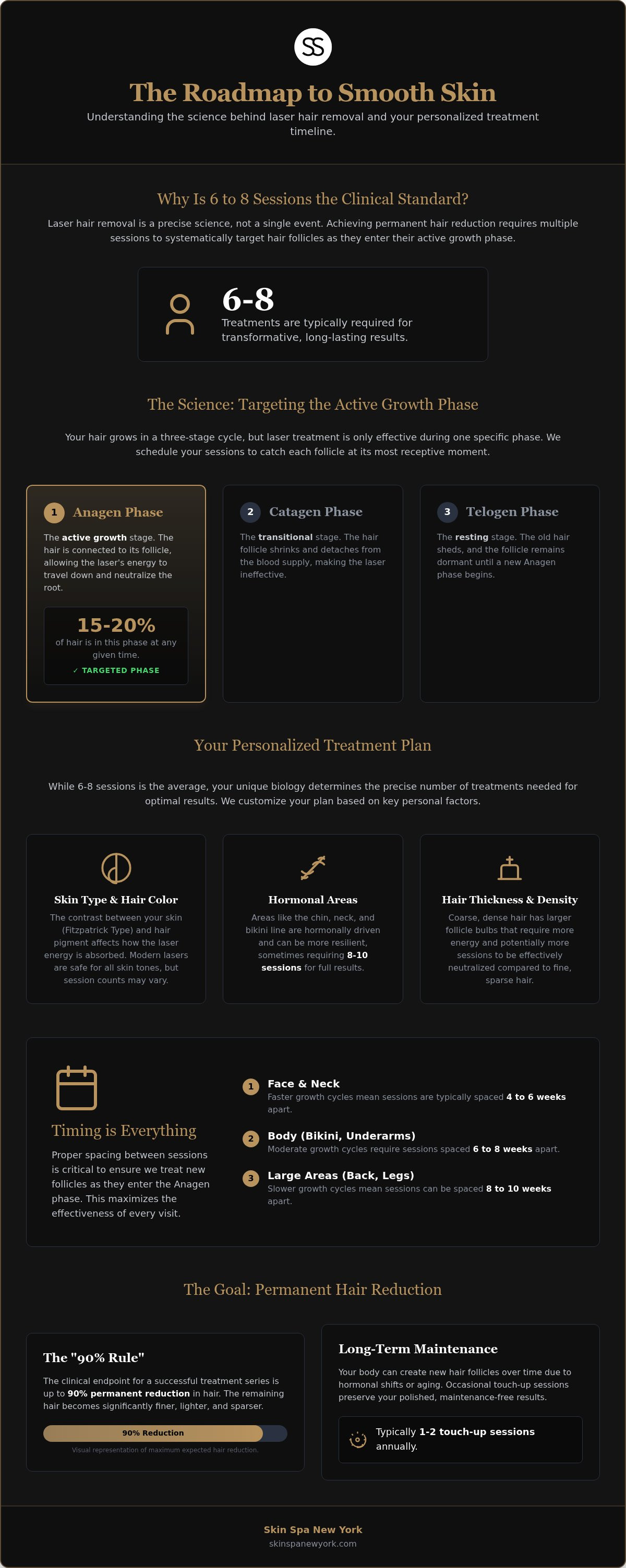
- Discover why 6 to 8 treatments is the clinical standard for most guests and how many sessions for laser hair removal you specifically might need based on your hair type.
- Learn why the Anagen phase is the only window for effective treatment and how to synchronize your appointments with this biological rhythm.
- Understand how personal factors, including the Fitzpatrick Scale and hormonal influences, shape a customized plan for your skin.
- Explore the essential 4-to-10 week spacing rule that ensures every session maximizes your path to maintenance-free skin.
- Gain clarity on the "90% Rule" of permanent hair reduction and how occasional annual touch-ups preserve your polished results.
The Science of Smooth: Why One Session Is Never Enough
Stepping into a professional clinical environment often comes with the hope of immediate transformation. While the initial results are encouraging, understanding how many sessions for laser hair removal you truly need requires looking beneath the surface of the skin. A single appointment is merely the introduction to a biological timeline. To reach the clinical standard of 6 to 8 sessions, we must align our technology with your body’s natural rhythms. This series ensures we address follicles that were dormant or resting during your previous visits, providing a comprehensive solution rather than a temporary fix. The Science of Smooth: Why One Session Is Never Enough relies on this meticulous, multi-step approach.
Understanding the Hair Growth Cycle
Your hair doesn't grow in unison. Instead, each follicle cycles through three specific stages: Anagen, Catagen, and Telogen. The Anagen phase is the star of the show. During this active growth period, the hair shaft is physically connected to the follicle bulb. The laser targets the pigment in the hair, sending heat down to neutralize that bulb and prevent future growth. In any given treatment, only about 15% to 20% of your hair is in this receptive state. The remaining hairs are either in Catagen, where the follicle shrinks, or Telogen, where the hair is preparing to shed. By spacing your visits, we ensure we capture each follicle as it rotates back into the Anagen phase.
The Clinical Goal: Permanent Hair Reduction
Transparency is a cornerstone of our professional care. When discussing how many sessions for laser hair removal are required, it's essential to understand the distinction between total removal and the clinical goal of permanent hair reduction. We aim for a significant, long-lasting decrease in hair count. You'll notice the first signs of success shortly after your first visit as treated hairs begin to shed. As you progress through the series, the hair that does return undergoes a dramatic transformation. It shifts from coarse and dark to fine, light, and sparse. This change in texture not only makes the hair less visible but also significantly reduces the risk of the skin irritation and ingrown hairs that once disrupted your confidence.
Factors That Dictate Your Personal Session Count
While the clinical average provides a helpful baseline, your journey to smooth skin is as unique as your DNA. Determining how many sessions for laser hair removal you require involves assessing several biological variables that influence how your follicles respond to light energy. At our clinics, we prioritize a bespoke approach, ensuring your treatment plan respects your body's specific needs while delivering the precision results you expect from a premier sanctuary. Your history, genetics, and even your metabolism play a part in this clinical timeline.
Customizing for Your Fitzpatrick Skin Type
The Fitzpatrick Scale is a professional tool we use to categorize skin tones based on their response to UV light and pigment levels. In the past, laser technology was limited to a narrow range of skin and hair contrasts, but modern advancements have changed that narrative. Today, we utilize medical-grade lasers that safely treat all skin tones, though the timeline often varies based on these profiles. For those with deeper complexions, a more cautious and deliberate multi-session approach is often necessary to ensure the highest level of skin safety. You can learn more about this in our guide to Fitzpatrick Skin Type: Identifying Your Laser Profile.
The Role of Hormones and Biology
Biology plays a significant role in the persistence of hair growth. Areas that are hormonally driven, such as the chin, neck, or bikini line, often prove more resilient than other parts of the body. For individuals managing conditions like PCOS or simply possessing a higher density of dormant follicles, the path to Beyond the Initial Series: Maintenance and Long-Term Results might involve 8 to 10 sessions rather than the standard six. This isn't a sign of treatment failure. Instead, it's a reflection of your body's regenerative speed and metabolic rate. Patience in these high-density areas is essential for achieving a polished finish.
Hair thickness and density also dictate the clinical timeline. Coarse, stubborn hair often requires more energy to neutralize the follicle bulb effectively. As you age, your hair growth patterns may shift, meaning a plan created in your twenties might look different than one designed in your forties. We invite you to speak with our specialized providers to determine exactly how many sessions for laser hair removal will best serve your aesthetic goals. By matching our expertise with your unique biology, we create a clear, predictable route to maintenance-free skin.
Mapping the Body: Session Estimates by Treatment Area
The geography of your body plays a pivotal role in your clinical timeline. While we’ve established the biological growth phases, the rate at which these phases occur varies significantly from your brow to your ankles. When planning how many sessions for laser hair removal you’ll need, it’s helpful to categorize areas by their growth speed and follicle depth. Smaller, high-contrast areas often yield satisfying results quickly, while larger expanses require a more patient, rhythmic approach to ensure no follicle is overlooked. This strategic mapping ensures your experience remains efficient and effective.
Face and Underarms: The Quick-Response Zones
Face and underarms are often the first areas guests choose for transformation. The underarms specifically are highly responsive, typically requiring around 6 sessions for significant clearance. However, the face presents a unique challenge. Facial hair grows much faster than body hair, requiring sessions to be spaced just 4 weeks apart. Because of this rapid cycling, you might actually need 8 or more total visits to achieve a polished, maintenance-free look. You can find more detail on this in our guide to Underarm Laser Hair Removal. Data supported by the Cleveland Clinic notes that while most people see a major reduction in about six treatments, facial areas often demand that extra level of persistence.
Large Scale Smoothing: Legs, Back, and Arms
For larger areas like the legs, back, and arms, the strategy shifts. The "Leg Advantage" refers to the fact that while the treatment surface is greater, the hair growth cycle is much slower. This allows for wider spacing, typically 8 to 10 weeks, and often results in faster visible clearance within 6 to 8 sessions. In contrast, the back often features deeper, more resilient follicles. Male clients frequently find that the full 8-session series is necessary to address the density and depth of these hairs. The size of the area naturally impacts the duration of each individual appointment, turning a quick underarm service into a more comprehensive, relaxing experience for full-body smoothing.
Precision relies on consistency. If you skip an appointment or wait too long between visits, you risk missing the vital Anagen window we discussed earlier. This doesn't just delay your results; it can effectively reset your progress by allowing follicles to return to a dormant state without being neutralized. Sticking to your bespoke schedule is the most efficient way to minimize the total number of visits. When guests ask how many sessions for laser hair removal are truly necessary, the answer always depends on their commitment to the clinical timeline we provide. Our specialized providers in NYC, Boston, and Miami work with you to ensure your appointments are timed for maximum follicle impact.
The Importance of Spacing: Why Timing Is Everything
Success in clinical aesthetics is rarely the result of a single event; it's the outcome of a perfectly timed sequence. While it's natural to focus on how many sessions for laser hair removal you'll need, the intervals between those visits are what truly define your results. We don't just schedule these appointments for convenience. We time them to match the biological "wake-up call" of your hair follicles. Precision timing ensures that every pulse of the laser captures a follicle in its most vulnerable state.
Arriving too early for a session presents a unique risk. If the next wave of follicles hasn't entered the active growth phase, you're essentially attending a "wasted session" where the laser has no target. On the other hand, waiting too long can allow hairs to transition into a dormant stage. This doesn't just delay your finish line; it can potentially reset your progress by allowing follicles to recover their regenerative strength. Consistency is the bridge between a routine chore and a permanent lifestyle upgrade.
The Clinical Calendar
We typically follow a standard interval of 4 to 6 weeks for the face and 8 to 10 weeks for the rest of the body. These windows reflect the different growth speeds we mapped in the previous section. As your treatment series progresses and your hair growth slows, your provider will likely extend these intervals. It's common for your final two sessions to be spaced significantly further apart than your first three. This customization ensures we are always treating "new" hair rather than revisiting follicles that have already been neutralized.
Seasonality and Skin Health
Winter is often considered the most sophisticated time to begin a laser series. Because your skin is naturally more protected from the sun during colder months, we can treat your follicles with maximum precision and safety. For our guests in the vibrant environments of NYC or Miami, managing summer sun exposure is a critical part of the process. UV-sensitized skin requires a more cautious approach, which is why following our strict Laser Hair Removal NYC pre-care protocols is essential for protecting your investment.
Your timeline to smooth skin is a collaborative journey between our expertise and your commitment. To ensure your sessions are perfectly synchronized with your body's rhythms, we invite you to book your clinical assessment today and begin your path to an effortless, maintenance-free lifestyle.
Beyond the Initial Series: Maintenance and Long-Term Results
Completing your initial series marks a significant shift in your self-care routine. You've moved from the constant cycle of temporary fixes to a state of clinical confidence. However, understanding how many sessions for laser hair removal you need also involves looking at the years ahead. We aim for what we call the 90% Rule. This represents a permanent reduction where the vast majority of hair is gone, and any that remains is fine, light, and barely visible. It's the difference between a daily struggle and a lifestyle of effortless elegance.
Life's natural transitions, such as pregnancy or menopause, can occasionally trigger new hair growth by activating previously dormant follicles. This is entirely normal. To address these stray hairs, we recommend a single maintenance session once or twice a year. These appointments are designed to be brief and efficient, ensuring your results remain as precise as the day you finished your series. By integrating these touch-ups with our other Advanced Medical Spa Services, you maintain a comprehensive approach to your skin’s health.
The Maintenance Phase
Annual touch-ups serve as a sophisticated insurance policy for your skin. They're shorter than your initial treatments because there's far less pigment for the laser to target. During these visits, we focus on perfection. We ensure that your skin remains as silky as possible, regardless of the biological changes your body might undergo. It's a proactive way to manage your appearance with minimal time investment. Most guests find that these occasional refinements are a small price to pay for the permanent freedom from razors and wax.
Skin Spa New York: Your Partner in Smoothness
Our commitment to your results doesn't end when your hair stops growing. At our sanctuaries in NYC, Boston, and Miami, we view laser hair removal as the foundation of a broader aesthetic journey. Once you've achieved smooth skin, many of our guests transition to skin rejuvenation treatments like Laser Genesis to refine their complexion further. This holistic approach ensures your skin isn't just hair-free, but also vibrant and healthy.
We invite you to speak with our specialized providers for a professional consultation. Together, we can determine the exact how many sessions for laser hair removal your unique biology requires and create a bespoke plan that evolves with your needs. Whether you're just starting your journey or looking to maintain a polished finish, we're here to provide the expertise and care you deserve.
Your Journey to Permanent Silkiness Starts Here
Reclaiming your time from temporary grooming methods is a transformation that begins with a single, scientifically timed step. We've explored how matching clinical precision with your body's natural growth rhythms ensures every visit is effective. While the question of how many sessions for laser hair removal typically lands between six and eight for most guests, your specific path is shaped by your unique biology and the treatment areas you choose. It's a clinical timeline designed to move you away from the frustration of razor burn toward the confidence of maintenance-free skin.
With over 15 years of clinical excellence, our expert providers in NYC, Boston, and Miami are trained to navigate all Fitzpatrick skin types within our sophisticated urban sanctuaries. We don't just offer a service; we provide a reliable roadmap to results. Ready to trade the irritation of razors for lasting, polished skin? Book Your Personalized Laser Consultation at Skin Spa New York and let us design a bespoke plan that fits your lifestyle. Your future of effortless, silky skin is within reach.
Frequently Asked Questions
How many sessions are needed for full Brazilian laser hair removal?
Most guests require 6 to 8 sessions to achieve significant, long-term hair reduction in the Brazilian area. Because the hair in this region is often coarser and deeper, it responds exceptionally well to our medical-grade lasers. We typically space these appointments 5 to 7 weeks apart to align with the specific growth cycle of the bikini area, ensuring we capture every follicle during its active phase.
Can I see results after just 1 session of laser hair removal?
You will notice visible changes after your first session, typically in the form of hair shedding and slower regrowth. About two to three weeks after your visit, treated hairs will begin to fall out naturally. While this initial result is encouraging, it's only the beginning of the process. Since only about 15% to 20% of your hair is active at once, subsequent visits are essential for a polished finish.
Why do I still have hair after 6 sessions of laser?
Seeing some hair after 6 sessions is a normal part of the process and often indicates that certain follicles were dormant during your previous appointments. Depending on your hair density and hormonal profile, you might simply require the upper end of the clinical range. This is why we emphasize a customized approach to determine exactly how many sessions for laser hair removal your specific biology requires for total silkiness.
Is it okay to shave between laser hair removal sessions?
Shaving is the only recommended method for managing hair between your scheduled sessions. You must avoid waxing, plucking, or epilating, as these methods remove the hair root entirely. The laser requires that root to be present to act as a target for the light energy. Keeping the area clean-shaven ensures the laser can focus its energy directly into the follicle bulb without any interference from surface hair.
How much time should I wait between my laser sessions?
The ideal wait time generally ranges from 4 to 6 weeks for facial areas and 8 to 10 weeks for the rest of the body. These intervals are carefully calculated to match the rate at which your follicles cycle back into the active growth phase. Your provider will monitor your progress and may extend these windows as your hair growth slows, ensuring each session provides the maximum possible impact.
Will laser hair removal work if I have a hormonal imbalance like PCOS?
Laser hair removal is highly effective for individuals with PCOS, though the clinical timeline often requires more persistence and patience. Hormonal fluctuations can stimulate new hair growth, which means you may need 10 or more initial sessions followed by regular maintenance. We specialize in these complex cases, providing a tailored plan to help you achieve the lasting confidence of smooth, maintenance-free skin.
What happens if I stop laser hair removal after 3 sessions?
Stopping after only 3 sessions will likely result in patchy, uneven hair growth as dormant follicles eventually return to their active state. While you'll have successfully neutralized a portion of your hair, you won't have completed the full cycle needed for permanent reduction. To protect your investment and achieve a truly polished result, it is vital to finish the entire series recommended by your provider.
Are the results of laser hair removal permanent forever?
The results are clinically defined as permanent hair reduction, meaning the vast majority of treated hair will not return. While neutralized follicles are gone, your body can occasionally develop new follicles over time due to natural aging or hormonal shifts. We recommend one or two brief maintenance sessions per year to manage any new growth and keep your results looking precise and your skin feeling effortlessly smooth.
