

The traditional narrative surrounding permanent hair reduction has often left those with auburn or strawberry blonde tones in a state of aesthetic limbo. If you've spent years being told you aren't a candidate or have worried about wasting resources on ineffective treatments, you're likely familiar with the specific laser hair removal for red hair limitations that have historically restricted access to this luxury. It is a common frustration, yet modern clinical advancements are beginning to shift the conversation from a flat refusal to a nuanced discussion of pigment chemistry.
We understand that your goal is clarity rather than another empty promise. In this article, you'll discover the scientific reality of how pigment types like pheomelanin influence laser absorption and how to determine if you are a candidate for clinical success. We will examine the technology that works best for red hair, such as specialized Alexandrite and Nd:YAG platforms. We also provide a clear roadmap for achieving the smooth, refined skin you deserve through professional, customized solutions that prioritize both your safety and your results.
Key Takeaways
- Understand how the biological distinction between eumelanin and pheomelanin dictates whether a laser can effectively target and treat your specific hair follicles.
- Navigate the specific laser hair removal for red hair limitations by identifying where your unique shade, from strawberry blonde to deep auburn, falls on the clinical success spectrum.
- Learn why Fitzpatrick Skin Typing is a critical safety measure for protecting fair skin from irritation and epidermal burns during the hair reduction process.
- Discover why certain advanced technologies, such as the 755nm Alexandrite laser, are often the preferred choice for addressing lighter hair pigments with precision.
- Gain the clarity needed to make an informed investment in your self-care, ensuring you pursue treatments that offer a high probability of professional, smooth results.
The Biology of Red Hair: Why Melanin Type Dictates Laser Efficacy
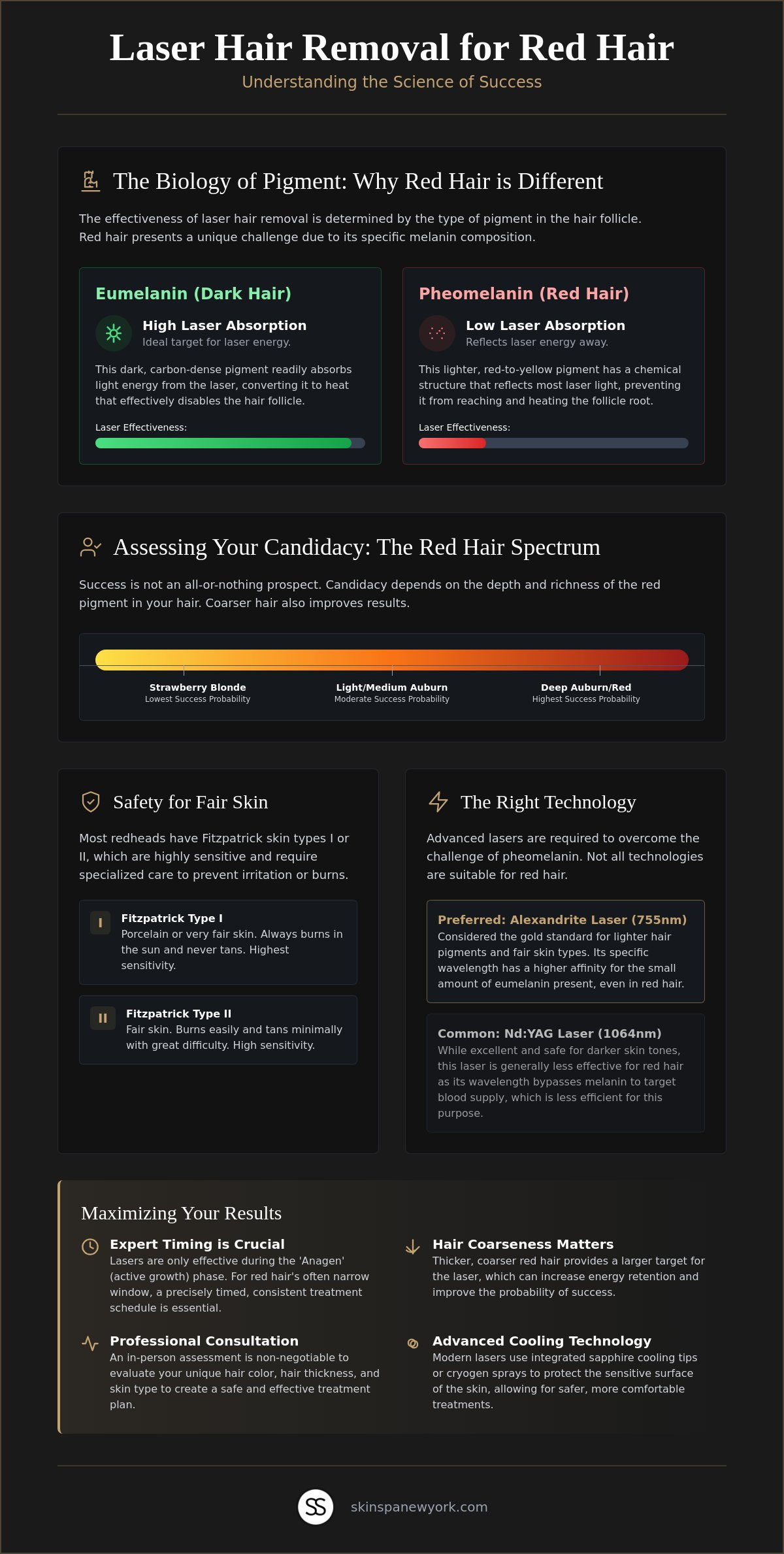
The journey to smooth skin is often a biological puzzle for those with crimson or copper tones. At the heart of this challenge lies the specific type of melanin residing within your hair follicles. While traditional lasers are typically calibrated to seek out the carbon-heavy structure of eumelanin, the dark pigment found in brown and black hair, red hair is primarily composed of pheomelanin. Understanding The Biology of Red Hair is the first step in managing laser hair removal for red hair limitations, as the treatment relies on a specific pigment profile to be effective. At the molecular level, the distinction is clear:
- Eumelanin: This dark, carbon-dense pigment is highly receptive to light energy, making it the ideal target for permanent hair reduction.
- Pheomelanin: This red-to-yellow pigment possesses a chemical structure that reflects light rather than absorbing it.
Pheomelanin serves as the primary chemical barrier to standard laser absorption because its molecular structure doesn't readily convert light energy into the heat required for follicular destruction. This creates what practitioners call the Red Hair Paradox. Many natural redheads possess Fitzpatrick Type I skin, which is characterized by its porcelain-like quality and high sensitivity. Traditional laser systems require a sharp contrast between the dark hair and light skin to function safely; without that contrast, the energy can't distinguish between the follicle and the surrounding tissue. This lack of distinction is one of the most significant laser hair removal for red hair limitations encountered in older clinical settings.
Eumelanin vs. Pheomelanin: The Laser's Target
In clinical terms, the laser treats the pigment in your hair as a chromophore, which is a molecule that absorbs specific light frequencies. Because pheomelanin reflects light in the red and yellow spectrum, the energy often bounces off the hair shaft rather than traveling down to the root. However, hair thickness can play a vital role in your success. Coarser red hair provides a larger target area for the laser, which can sometimes allow for better energy retention even when the pigment levels are lower than those found in darker hair types.
The Role of the Hair Growth Cycle
Precision is paramount when treating lighter follicles that are already resistant to light energy. Laser energy only effectively disables hair during the Anagen phase, which is the period when the hair is actively connected to the blood supply. For redheads, the window of opportunity is often narrower and requires expert timing. Hormonal fluctuations can also influence the density and texture of red hair, making a customized schedule essential for success. Consistent, expertly timed sessions ensure we catch as many follicles as possible during this high-growth state, maximizing the potential for permanent reduction.
Fitzpatrick Skin Typing: Navigating the Risks for Fair-Skinned Clients
Safe and effective aesthetic treatments begin with a deep understanding of your skin's unique physiology. In the clinical world, we use the Fitzpatrick Scale to categorize skin based on its reaction to UV light and its melanin content. Most natural redheads fall into the Type I or Type II categories, which represent the most delicate end of the spectrum. These skin types are characterized by a high tendency to burn and a limited ability to tan. Because the skin itself lacks a significant amount of protective melanin, assessing your candidacy requires a practitioner who respects the thin line between an effective treatment and an adverse reaction.
One of the primary laser hair removal for red hair limitations involves the clinical risk of over-treating the area. When hair pigment is light, there is often a temptation to increase the laser's energy settings to force a result. However, on fair skin, this significantly increases the risk of epidermal burns or long-term pigment changes. Modern technology has mitigated much of this risk through integrated cooling systems. These sapphire cooling tips or cryogen sprays protect the skin's surface, allowing us to deliver higher energy levels to the follicle while keeping the surrounding tissue at a safe, comfortable temperature.
It is also essential to manage expectations regarding the final outcome. While many seek a total "clearing" of hair, the FDA technically clears these devices for permanent hair reduction rather than absolute removal. For the red hair demographic, this distinction is vital. You can expect a significant decrease in hair density and a change in texture, but a few fine, light hairs may remain. Achieving this level of refinement is much easier when you partner with experts who offer professional laser hair removal services tailored to sensitive skin profiles.
Why Type I Skin Requires Specialized Expertise
Type I skin is exceptionally reactive because it lacks the "shield" of dark melanin. At Skin Spa New York, our practitioners use precise calibration to ensure the laser energy bypasses the epidermis and targets only the root. We prioritize the integrity of your skin barrier above all else. This process always begins with a mandatory test patch. This small, controlled application allows us to observe how your specific skin and hair react before proceeding with a full session, ensuring your safety and peace of mind.
Sun Exposure and the Fair-Skinned Professional
Maintaining the health of your skin requires a proactive approach to sun protection. Redheads must be particularly vigilant about UV exposure both before and after their appointments. In cities like New York or Boston, the winter months often provide the ideal window for treatment, as sun exposure is naturally minimized. Conversely, if you are visiting our Miami locations during the summer, you must be rigorous with high-SPF protection and shade. Post-treatment care for reactive skin should focus on soothing topicals and avoiding heat, allowing your delicate skin to recover and reveal its new, smooth texture.
Assessing Your Candidacy: The Red Hair Spectrum
Red hair is far from a uniform category; it's a diverse spectrum of copper, gold, and crimson tones. Determining your candidacy requires a look beyond the surface. As the Mayo Clinic explains melanin's role, the ratio of dark to light pigment is what creates the necessary thermal reaction. If your hair leans toward a deep auburn or rich copper, you likely possess enough eumelanin for the laser to effectively target the follicle. These darker shades often see significant success, as the "fuel" for the laser is present in higher concentrations.
Contrast this with the strawberry blonde challenge. Very light red hair remains the most difficult to treat because it lacks the carbon-heavy structure needed for energy absorption. In these cases, the laser hair removal for red hair limitations are most pronounced. However, the "Root Test" often reveals a different story. By examining the hair bulb under the skin, we can see if the pigment is concentrated at the base, even if the visible shaft appears light. This hidden pigment is often the key to unlocking clinical success.
Body area also plays a pivotal role in results. You may find that hair in hormonal areas, such as the underarms or pubic region, is naturally coarser and darker than the hair on your arms or legs. This increased density and pigment concentration often make these areas more responsive to treatment, even for those with lighter hair elsewhere. We evaluate these variables to ensure your expectations align with biological reality.
A Guide to Hair Shades and Expected Outcomes
Success for redheads is defined by refinement and a reduction in daily maintenance. While dark hair often sees near-total clearance, a 70% to 80% reduction is considered a significant win for the red hair demographic. Auburn shades typically respond with high efficiency, while copper tones require more precise calibration. If your hair is "blunt" red or very light, we might suggest a hybrid approach, integrating other professional treatments to achieve the smooth texture you desire.
The Consultation: The Only Way to Know for Sure
A professional assessment at Skin Spa New York is the most reliable way to gauge your potential. During your visit, we don't just look at your current shade; we discuss your genetic history and how your hair color has evolved. We evaluate the pigment available in your follicles to ensure that any treatment plan we design is rooted in clinical honesty. If we don't believe you'll see the results you're looking for, we'll tell you, because your trust is our most valued asset.
Comparing Technologies: Which Lasers Work Best for Red Pigment?
Achieving a refined result requires moving beyond a one-size-fits-all approach to aesthetic technology. The effectiveness of your treatment rests entirely on the wavelength of light being utilized. When addressing laser hair removal for red hair limitations, the goal is to find a wavelength that is absorbed aggressively by pheomelanin without damaging the surrounding fair tissue. Not all light is created equal, and choosing the wrong system can lead to frustration or skin irritation.
The 755nm Alexandrite laser is often considered the premier choice for the red hair demographic. Its shorter wavelength has a higher absorption coefficient for melanin, meaning it can see lighter pigments that other systems might miss. Conversely, the 1064nm ND:YAG laser is the gold standard for darker skin tones because its longer wavelength bypasses the epidermis to protect the skin; however, this makes it significantly less effective for red hair. Diode lasers occupy a middle ground, offering high-speed efficiency that works well on coarse, darker red hair. We must also distinguish these from Intense Pulsed Light (IPL). While we offer Lumecca IPL for skin rejuvenation, it is not a true laser and generally lacks the concentrated power required to disable stubborn red follicles.
Alexandrite vs. Diode for Redheads
The absorption coefficient of the 755nm wavelength allows it to target the finer, lighter pigments found in strawberry blonde and copper hair with exceptional precision. At Skin Spa New York, we utilize medical-grade technology to ensure every pulse is calibrated for your specific hair density and skin sensitivity. While Alexandrite lasers deliver energy in intense, focused bursts through a crystal medium, Diode lasers use semiconductor technology to provide a steady, rapid pulse across larger surface areas. Understanding these laser hair removal for red hair limitations is essential before investing in any specific technology.
The Truth About At-Home Laser Devices
Consumer-grade IPL devices are almost universally ineffective for red hair because they lack the power to target pheomelanin successfully. Beyond the lack of results, these devices pose a significant safety risk for those with Fitzpatrick Type I skin. Without professional-grade cooling and expert calibration, the risk of epidermal burns on fair skin is unacceptably high. True clinical success requires the oversight of a trained practitioner who can adjust settings in real-time. To ensure your journey to smooth skin is both safe and effective, we recommend you schedule a professional laser hair removal session at one of our premier locations.
The Skin Spa New York Approach to Specialized Hair Removal
At Skin Spa New York, we believe that clinical excellence is inseparable from honesty. We recognize that while technology has advanced significantly, the specific laser hair removal for red hair limitations mean that not every individual with auburn or strawberry blonde tones is a suitable candidate for light-based treatments. Our practitioners prioritize your results over a transaction. If we determine that your hair lacks the necessary pigment to achieve a successful outcome, we'll provide a transparent assessment rather than an ineffective treatment plan. This commitment to integrity is why we remain a trusted destination for Laser Hair Removal NYC clients rely on for professional, predictable results.
Our approach blends high-end hospitality with rigorous medical standards, creating a sanctuary where your aesthetic goals are met with precision. For those whose hair profile may not respond to lasers, we offer a curated selection of alternatives to ensure you still achieve a polished, radiant look. Whether it's a series of customized facials to refine skin texture or Laser Genesis to address redness and tone, our goal is to provide a comprehensive roadmap for your self-care journey. We serve guests across New York, Boston, and Miami, adapting our protocols to meet the unique environmental challenges of each city, from the intense Florida sun to the dry, cold winters of the Northeast.
Customization Beyond the Laser
For clients who aren't ideal laser candidates, we specialize in managing the secondary concerns that often lead people to seek hair removal, such as persistent ingrown hairs. Our team is deeply trained in Fitzpatrick skin type identification, ensuring that every treatment, from chemical peels to microdermabrasion, is safe for delicate, reactive skin. The Skin Spa Sanctuary experience ensures that even the most clinical procedures are delivered in a refined, relaxing environment that respects your time and your comfort.
Preparing for Your First Session
Success begins before you even step into our treatment room. For red-prone, sensitive skin, we recommend avoiding all active retinoids and harsh exfoliants for at least one week prior to your visit. When you arrive for your consultation, please be prepared to discuss your genetic hair history and your current skincare routine. This data allows us to calibrate our technology with absolute accuracy. If you're ready to move past the uncertainty and discover what's possible for your skin, book your clinical consultation at Skin Spa New York today and experience the difference of a truly personalized approach.
Your Path to Clinical Clarity and Smooth Skin
Navigating the nuances of permanent hair reduction requires a blend of scientific understanding and professional honesty. You now have the clarity to distinguish between the various red pigments and the specific technology required to address them effectively. While understanding laser hair removal for red hair limitations is essential for setting realistic expectations, it shouldn't deter you from seeking the smooth, refined results you deserve. Success is often a matter of matching the right wavelength to your unique biological profile.
Since 2005, our practitioners have combined clinical expertise with high-end hospitality to serve guests across our premier NYC, Boston, and Miami locations. We prioritize your safety through specialized training in Fitzpatrick Skin Types, ensuring every session is as protective as it is transformative. If you're ready to move beyond guesswork and embrace a customized plan tailored to your unique chemistry, we're here to guide you. Take the next step toward the confidence of lasting smoothness by choosing a partner who values your results as much as you do.
Schedule Your Professional Consultation at Skin Spa New York today. We look forward to welcoming you into our sanctuary and helping you achieve the polished look you've been searching for.
Frequently Asked Questions
Can redheads get laser hair removal successfully in 2026?
Yes, many redheads can achieve significant results in 2026, though success varies based on the specific ratio of pheomelanin to eumelanin. While traditional systems often struggled, modern multi-wavelength platforms allow for a permanent reduction of up to 70-85% in suitable candidates. It's essential to have a professional evaluation to determine if your specific pigment profile will respond to current clinical technology.
What happens if a laser is used on hair that is too light?
If a laser is applied to hair that lacks sufficient pigment, the light energy simply fails to absorb into the follicle. Instead of destroying the hair root, the energy may dissipate or be absorbed by the surrounding skin, increasing the risk of irritation. This is why we prioritize clinical honesty; treating hair that is too light results in a lack of efficacy and wasted resources.
Is electrolysis a better option for red hair than laser?
Electrolysis remains the only FDA-approved method for absolute permanent hair removal and is often the superior choice for very light strawberry blonde or white hairs. While laser is faster for larger areas, it relies on pigment to function. If your hair lacks the necessary "fuel" for a laser to see, electrolysis provides a reliable, though more time-consuming, alternative for achieving completely smooth skin.
Does the shade of red (auburn vs. strawberry blonde) change the price of treatment?
Treatment pricing is typically determined by the size of the area being treated rather than the specific shade of your hair. However, because strawberry blonde hair often presents more laser hair removal for red hair limitations, you might require a different number of sessions compared to someone with deep auburn hair. We focus on creating a customized plan that reflects your unique biological needs and aesthetic goals.
How many sessions do redheads typically need for permanent reduction?
Redheads often require more sessions than those with darker hair, with some clinical data suggesting up to 12 sessions for optimal results. Because redheads often face unique laser hair removal for red hair limitations, a more extended series of treatments ensures we catch the highest percentage of follicles during their active growth phase. Consistency is the key to moving from temporary thinning to lasting, professional-grade reduction.
Can I use laser hair removal for red hair on my face?
Yes, laser treatments are highly effective for managing red hair on the face, including the chin, upper lip, and sideburns. We use specialized settings and cooling technology to protect the delicate facial skin while targeting the hair follicles. This precision ensures a refined, polished appearance without the daily irritation of shaving or the discomfort of frequent waxing and plucking.
What are the risks of laser hair removal for someone with very fair skin?
The primary risks for those with Fitzpatrick Type I skin include epidermal burns, blistering, or temporary pigment changes if the laser is not correctly calibrated. Fair skin lacks protective melanin, making it more vulnerable to the heat generated during the process. Our practitioners use advanced cooling systems and conservative energy settings to navigate these risks while still achieving meaningful and safe follicular disruption.
Will my red hair grow back thinner after laser even if it's not fully removed?
Yes, even when full clearance isn't achieved, the hair that returns is typically much finer, lighter, and softer in texture. This process, known as miniaturization, makes the remaining hair significantly less noticeable and much easier to manage. For many, this transformation in hair quality is a major success, as it reduces the frequency and intensity of traditional grooming routines and improves overall skin texture.
