

While you may not consider your summer wardrobe until the first warm weekend of May, the most sophisticated approach to achieving smooth, radiant skin begins long before the temperature rises. If you wait until beach season to address unwanted hair, you're often left managing the familiar discomfort of razor burn and persistent ingrown hairs just when you want to feel your most confident. Understanding the best time of year to start laser hair removal is not merely about convenience; it's a strategic decision that respects your skin's natural biology and the clinical requirements of the technology.
We understand that balancing the demands of sun exposure with your aesthetic goals can feel complex. This article provides the clarity you need to plan your journey with precision, ensuring your treatments are both safe for your specific skin tone and perfectly timed for the results you desire. You'll discover why the cooler months offer a unique seasonal advantage for your skin's recovery and receive a clear roadmap of the sessions required to transition seamlessly into a hair-free lifestyle. By aligning your schedule with these professional insights, you can transform your routine from a daily chore into a lasting state of refinement.
Key Takeaways
- Align your treatment schedule with the hair’s anagen growth phase to ensure every session delivers maximum impact for lasting smoothness.
- Explore why the post-Labor Day window is the best time of year to start laser hair removal, providing a safe environment for your skin to heal away from direct sun.
- Identify "sun-safe" zones like the underarms that allow you to begin your transformation with confidence even during the height of the summer season.
- Learn how to adjust your skin’s hydration and protection needs based on your local environment, whether you are navigating the bustle of NYC or the warmth of Miami.
- Understand the role of professional consultations in designing a customized protocol that prioritizes both safety and precision for your specific skin tone.
Why the Calendar Dictates Your Laser Hair Removal Success
Achieving a state of permanent smoothness is as much about biology as it is about technology. Laser hair removal functions as a light-based treatment that specifically targets the melanin, or pigment, located within the hair follicle. When the laser's energy is absorbed, it transforms into heat, which gently disables the follicle's capacity for future growth. Because this process relies on the laser identifying pigment, the relationship between your skin tone and your hair color becomes the primary factor in your treatment's success.
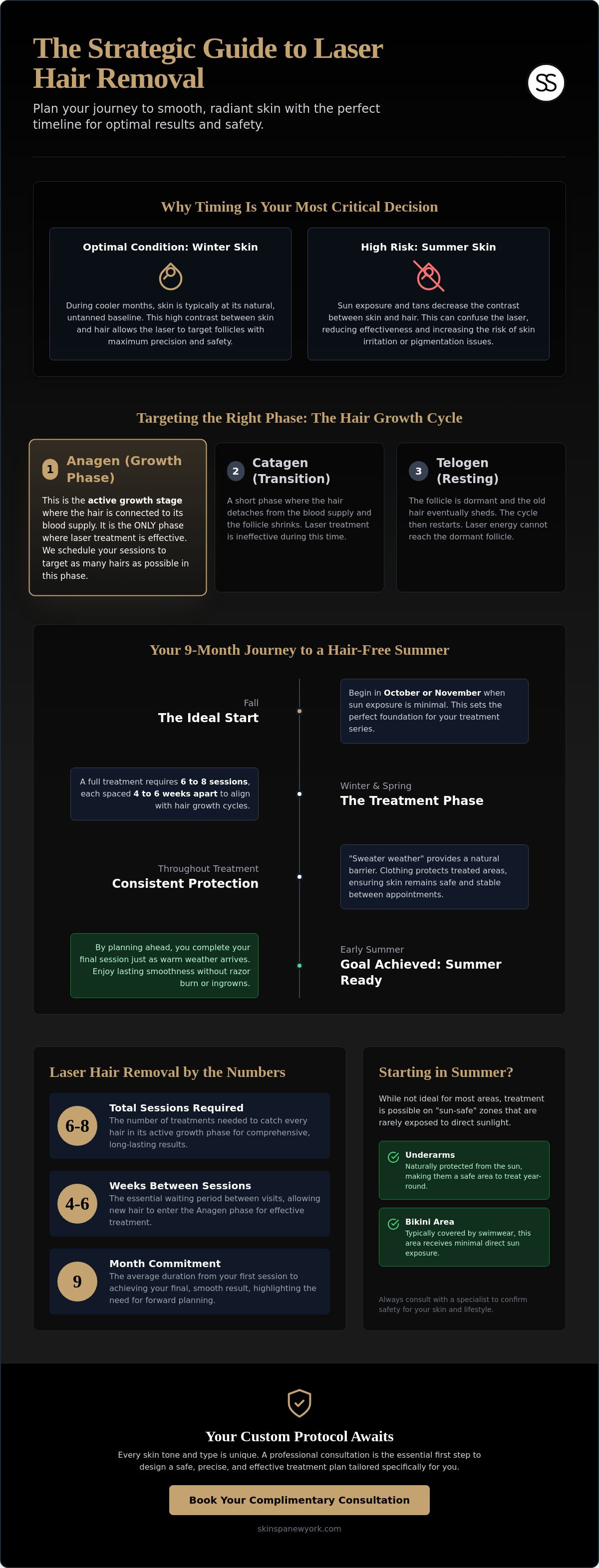
This biological interaction is further influenced by the three stages of hair growth. Your hair is constantly moving through a cycle of renewal:
- Anagen: This is the active growth phase. It's the only time the hair is physically connected to the follicle's blood supply, making it the only phase where laser energy can effectively destroy the root.
- Catagen: A short transitional period where the hair follicle shrinks and detaches from the dermal papilla.
- Telogen: The resting phase where the hair eventually sheds, and the follicle remains dormant before starting the cycle again.
Since only a fraction of your hair is in the anagen phase at any moment, a single session cannot provide comprehensive results. You need a series of strategically timed appointments to catch every hair in its active state. This requirement introduces the "Sun-Laser Paradox." If your skin is tanned from recent sun exposure, the laser may have difficulty distinguishing between the hair follicle and the surrounding skin. Consequently, the best time of year to start laser hair removal is during the months when your skin is at its most natural, untanned baseline.
The Role of Melanin and Contrast
In the early days of aesthetic technology, "winter paleness" was the gold standard for clinical safety. The stark contrast between light skin and dark hair allowed lasers to work with unmatched precision. While modern technology at Skin Spa New York has evolved to treat a much broader range of Fitzpatrick skin types safely, maintaining a stable skin tone remains vital. Starting in the cooler months minimizes the risk of hyperpigmentation and ensures our specialists can calibrate the equipment for the most effective results possible.
The 6-to-9 Month Commitment
Patience is a prerequisite for excellence. A successful series usually requires 6 to 8 sessions, with essential 4-to-6 week gaps between each visit to respect the hair's natural growth rhythm. This means that achieving a completely hair-free silhouette is a three-quarter year commitment that requires foresight and planning. When you begin your journey in the autumn, you are perfectly positioned to finish your final session just as the first days of summer arrive.
Fall and Winter: The Gold Standard for Starting Treatment
As the vibrant energy of summer transitions into the crisp clarity of autumn, the focus of self-care often shifts toward restoration. While many prioritize renewing their complexions after sun exposure, savvy clients recognize that the post-Labor Day window is the best time of year to start laser hair removal. This timing isn't accidental; it's a strategic alignment with the shortest days of the year. By beginning your journey in the fall, you allow yourself a spacious 6 to 9 month window to complete a full series of treatments. The goal is clear: you want to finish your final session just as the layers come off in May, ensuring you're summer-ready without the last-minute stress of managing razor burn.
The clinical benefits of a winter start are significant. During these months, your skin is typically at its most natural, untanned state, which provides the ideal baseline for our advanced laser systems. According to the American Academy of Dermatology, multiple treatments are necessary to achieve the desired results, and these must be spaced 4 to 6 weeks apart. Starting in October or November provides the necessary runway to navigate this schedule without interruption, leading you toward a season of effortless confidence.
The Advantage of 'Sweater Weather' Protection
The arrival of cooler temperatures brings a natural ally to your laser journey: your wardrobe. Clothing acts as a reliable physical barrier, shielding your skin from the UV rays that can increase sensitivity during the healing process. For popular treatment areas like the legs, back, and bikini line, winter layers offer a discreet way to manage the post-laser period. It's essential to keep treated follicles cool and free from excessive friction immediately following a session. Soft, breathable winter fabrics provide this protection effortlessly. This seasonal buffer allows your skin to recover in a controlled environment, away from the heat and humidity that can sometimes cause irritation during the summer months.
Strategic Planning for Winter Sun Seekers
While the local climate might be overcast, we always account for the "holiday travel" exception. If you're planning a tropical getaway to Miami or the Caribbean, your treatment timeline requires professional coordination. Tanned skin requires a temporary pause in sessions to ensure maximum safety and efficacy. We recommend notifying your specialist about upcoming travel so we can adjust your protocol accordingly. Even during a gray New York or Boston winter, broad-spectrum SPF remains a vital part of your daily routine for any exposed areas. If you're ready to begin your transition to smooth skin, scheduling a session for laser hair removal now ensures you stay on track for a flawless summer.
Can You Start Laser Hair Removal in the Summer?
While we've established that the post-Labor Day window is often the best time of year to start laser hair removal for full-body transformations, you don't necessarily need to wait for the first frost to begin your journey. The belief that lasers and summer sun are entirely incompatible is a myth we frequently debunk for our guests. The key lies in strategic area selection and a disciplined clinical protocol. Areas that rarely see direct sunlight, such as the underarms or specific bikini styles, are excellent candidates for a summer start. These "sun-safe" zones remain protected by your daily attire, allowing our specialists to maintain the necessary contrast between the follicle and the skin.
However, for more exposed areas, we implement a strict "Summer Protocol." This involves unwavering SPF adherence and a zero-tanning policy. Without these precautions, treating sun-exposed skin significantly increases the risk of Post-Inflammatory Hyperpigmentation (PIH). This condition occurs when the skin's melanocytes overreact to the laser's heat, leading to temporary but undesirable darkening of the treated area. Our summer safety standards include:
- Strict UV avoidance: Keeping the treated area out of direct sunlight entirely for the duration of the healing phase.
- High-potency protection: Applying broad-spectrum SPF 30 or higher every two hours when outdoors.
- Protective styling: Utilizing UPF-rated clothing or wide-brimmed hats for those pursuing facial treatments.
The Summer-Ready Countdown
If you begin in March or April, you're on a 12-week "last call" timeline. While you won't be completely hair-free by July, you'll experience a noticeable reduction in density and thickness after just two sessions. This partial result means fewer ingrown hairs and a much smoother experience during your mid-summer beach trips. It's an incremental refinement that yields immediate lifestyle benefits. Starting now ensures that by the time next year's summer arrives, you'll have already completed the bulk of your protocol, leaving only minor maintenance if needed.
Safety Protocols for Sun-Kissed Skin
We enforce a mandatory 2-week "no sun" rule both before and after each session. This ensures your skin's baseline is stable and reduces the risk of irritation or thermal injury. Additionally, self-tanners and spray tans are strictly prohibited during your treatment cycle. These products deposit pigment on the skin's surface, which can confuse the laser and lead to sub-optimal results or potential skin damage. Maintaining complete transparency with your aesthetician regarding recent sun exposure is the single most critical factor in preserving your skin's health and ensuring a safe, effective clinical outcome.
Geography and Skin: Tailoring Your Timeline to NYC, Boston, or Miami
The geographic context of your daily life plays a pivotal role in determining the best time of year to start laser hair removal. While the biological principles of hair growth remain constant, the environmental variables of your specific city dictate how you must manage sun exposure and skin hydration. In the urban landscapes of New York and Boston, the stark contrast between seasons provides a natural structure for your treatment plan. Conversely, our guests in Florida must navigate a climate of perpetual brightness, requiring a more nuanced approach to clinical safety. Understanding these regional differences ensures your protocol is as effective in the humidity of South Beach as it is in the dry winters of New England.
Your position on the Fitzpatrick scale, a professional classification of skin types based on their reaction to UV light, also influences your ideal start date. Those with skin profiles more prone to tanning may find the deep winter months essential for establishing a safe baseline. At Skin Spa New York, we specialize in urban-specific skincare timing, helping you align your aesthetic goals with the realities of your local climate and lifestyle.
The Miami Strategy: Year-Round Vigilance
For our Miami clients, the concept of a "winter break" from the sun is largely non-existent. In high-UV environments, successful laser hair removal requires year-round vigilance rather than seasonal adjustments. We recommend a regimen rich in high-potency antioxidants and the consistent use of physical blockers like zinc oxide to maintain skin integrity. It is also vital to schedule your sessions around peak outdoor event seasons. If you plan to spend long days outdoors for Art Basel or the annual boat shows, we coordinate your appointments to ensure a safe buffer of time both before and after these high-exposure periods.
NYC and Boston: Navigating the Seasonal Shift
In the Northeast, the challenge is often the "Spring Surge." As the first warm days of April arrive, our booking calendars fill rapidly with guests realizing summer is imminent. To avoid scheduling difficulties, we advise starting your series during the quietest months of November or December. However, the harsh, skin-drying winters of NYC and Boston present their own clinical hurdles. Laser technology performs best on healthy, hydrated tissue, so addressing winter-chaffed skin with medical-grade moisturizers is a prerequisite for your sessions. Many of our clients find that linking their hair removal journey to a broader winter "skin renewal" phase, often paired with Chemical Peels or Laser Genesis, provides a comprehensive transformation by spring. To ensure your spot in our seasonal rotation, we invite you to book your laser hair removal consultation today.
Designing Your Custom Laser Protocol at Skin Spa New York
Every journey toward permanent smoothness begins with a sophisticated understanding of your unique biological profile. While we've identified the best time of year to start laser hair removal as the cooler months, the specific calibration of your treatment depends on a professional consultation. At Skin Spa New York, we move beyond one-size-fits-all solutions by utilizing advanced technology designed to treat a wide range of Fitzpatrick skin types with clinical precision. This initial meeting allows our experts to assess your hair density, skin sensitivity, and history to create a roadmap that prioritizes both safety and transformative results. We invite you to step into our sanctuary, where high-end hospitality meets the rigorous standards of modern aesthetic medicine.
Beyond Hair Removal: The Total Skin Sanctuary
Achieving a flawless silhouette is often part of a broader commitment to self-care. We encourage our guests to integrate their hair removal series with other specialized treatments to maintain a comprehensive glow. For instance, pairing your laser sessions with Customized Facials can help manage skin hydration and health as the seasons shift. The reduced UV exposure during the fall also makes it the ideal season to pursue deeper remodeling treatments like Morpheus8 NYC or intensive chemical peels. By working with a Skin Spa expert, you can design a 12-month aesthetic calendar that addresses everything from skin texture to permanent hair reduction, ensuring every layer of your routine is perfectly timed for the best time of year to start laser hair removal and other renewal services.
Your Next Steps to Smooth Skin
Preparation is the hallmark of a successful clinical experience. When you arrive for your first consultation, please bring a comprehensive list of any medications you're currently taking and a brief history of your previous hair removal methods. Our process always includes a mandatory patch test. While some facilities may prioritize speed, we prioritize your skin's long-term health; this small test ensures your skin reacts beautifully to the laser's settings before we proceed with a full session.
The transition to a care-free lifestyle doesn't happen overnight, but it does start with a single, well-timed decision. By initiating your protocol during the autumn or winter, you're giving your skin the luxury of time to heal and respond. You'll emerge into the summer of 2026 with a sense of refined confidence, entirely free from the daily burden of temporary hair removal. We look forward to guiding you through this transformation with the expertise and personalized attention you deserve.
Step Into a Season of Effortless Confidence
Achieving lasting results is a strategic journey that begins with a clear understanding of your skin's unique needs and the environmental factors of your specific city. By aligning your treatment with the cooler months, you prioritize clinical safety and ensure your skin is fully prepared for the first days of summer. We've explored how a dedicated six to nine month window allows for the most effective results, respecting the natural growth cycles of your hair while avoiding the complications of high UV exposure.
Since our founding in 2005, Skin Spa New York has provided over two decades of aesthetic expertise to guests across NYC, Boston, and Miami. We utilize advanced medical-grade laser technology that's safe for all skin types, ensuring every protocol is as precise as it is comfortable. Recognizing that the fall and winter months represent the best time of year to start laser hair removal, we invite you to begin your transformation within our refined urban sanctuaries. Book Your Consultation at Skin Spa New York today to secure your timeline for a radiant, care-free silhouette. Your future self will appreciate the foresight you show today.
Expert Insights for Your Laser Journey
Is it too late to start laser hair removal for this summer?
It is not too late to begin, though you should expect a significant reduction in hair density rather than total removal before your first beach day. Starting in the spring allows for one or two sessions, which thins the hair and reduces the frequency of shaving. While you won't be completely hair-free, the improvement in skin texture and the decrease in ingrown hairs provide immediate benefits for the warmer months.
How many months before my wedding or vacation should I start laser?
You should ideally begin your journey 6 to 9 months before your special event to ensure a complete cycle of treatments. Since sessions are spaced 4 to 6 weeks apart to catch hair in the active growth phase, this timeline allows for the 6 to 8 sessions typically required for flawless results. Planning ahead ensures your skin is fully recovered and perfectly smooth for your wedding or tropical getaway.
Can I get laser hair removal if I have a tan?
You must wait until your tan has completely faded before proceeding with a laser session to ensure clinical safety. Tanned skin contains active melanin that can absorb the laser's energy, increasing the risk of burns or hyperpigmentation. We require a minimum of two weeks without direct sun exposure or self-tanning products to establish a stable baseline for our advanced medical-grade technology.
What happens if I skip a month during my laser hair removal series?
Skipping a month won't reset your progress, but it may require additional sessions to achieve your desired outcome. Consistency is vital because the laser only targets hair in the active growth phase. If you miss the window for a specific group of follicles, you'll have to wait for them to cycle back to the anagen stage. Maintaining a steady schedule is the best way to ensure efficiency.
Is laser hair removal safe for dark skin during the summer months?
Laser hair removal is safe for dark skin during the summer as long as the treated area is strictly protected from UV exposure. We utilize specialized technology designed for higher Fitzpatrick skin types, but sun-sensitized skin remains a risk factor. If you can commit to high-potency SPF and physical coverage, you can safely continue your protocol through the brighter months without compromising your skin's health.
Can I shave between laser hair removal sessions in the winter?
You are encouraged to shave between sessions, as it keeps the hair follicle intact for the next treatment. Unlike waxing or plucking, which remove the root, shaving only clears the surface hair. This is particularly easy during the winter when treated areas are covered by clothing. Please ensure you arrive at your appointment with the area freshly shaved to allow the laser to target the root effectively.
Does the cold weather affect laser hair removal healing?
Cold weather actually aids the healing process by keeping the skin cool and reducing post-treatment inflammation. Low temperatures prevent the excessive sweating and heat retention that can sometimes irritate follicles after a session. However, winter air can be dehydrating, so it's essential to use a medical-grade moisturizer to maintain the skin's barrier while you navigate the best time of year to start laser hair removal.
Which areas are safest to treat during high-sun seasons?
The safest areas to treat during high-sun seasons are those traditionally covered by clothing, such as the underarms, bikini line, or torso. These zones are rarely exposed to direct UV rays, which minimizes the risk of sensitivity or pigment changes. For more exposed areas like the face or lower legs, we recommend waiting for the cooler months or practicing extreme sun avoidance to maintain clinical standards during the best time of year to start laser hair removal.