

The most transformative skin resurfacing acid in modern aesthetics is also one you should never attempt to apply in your bathroom mirror. If you feel exhausted by gentle over-the-counter serums that barely touch deep texture, yet anxious about the crusting, unpredictable downtime, and pigment risks highlighted across social media, you aren't alone. It's completely natural to wonder whether a medical-grade tca peel is genuinely safe and effective for your unique skin tone.
When administered with personalized care by licensed professionals, trichloroacetic acid shifts from an intimidating compound into an extraordinary tool for dermal rejuvenation. It works beneath the surface to remodel rough texture, soften pronounced wrinkles, and lift stubborn post-inflammatory hyperpigmentation with clinical precision. You don't have to second-guess solution depths or fear lasting damage when advanced protocols protect your barrier every step of the way.
Below, we outline everything you need to know about professional peel strengths, safe preparation for diverse complexions, and realistic recovery timelines so every patient can proceed with total confidence.
Key Takeaways
- Understand how a professional tca peel uses controlled keratocoagulation to eliminate damaged surface cells and initiate deeper collagen synthesis.
- Learn how precise acid concentrations and biological frosting endpoints determine peel depth, ensuring targeted correction for fine lines and stubborn dyschromia.
- Discover why unmonitored home applications present serious risks of scarring or burns, and how clinical supervision guarantees safety.
- Review essential pre-conditioning steps and realistic recovery protocols that minimize peeling downtime across diverse complexions.
- Explore how customized chemical exfoliation and advanced technologies work together to achieve lasting rejuvenation tailored to each patient.
Understanding the TCA Peel: Mechanism and Clinical Benefits
A professional tca peel represents one of the most reliable modalities in clinical dermatology for structural skin renewal. Unlike gentle fruit enzymes that only dissolve loose surface debris, trichloroacetic acid is an organo-chemical exfoliant designed to lift accumulated photo-damage and restore uneven skin tone. The secret behind its effectiveness lies in a precise biological reaction known as keratocoagulation.
How Trichloroacetic Acid Renews the Cellular Matrix
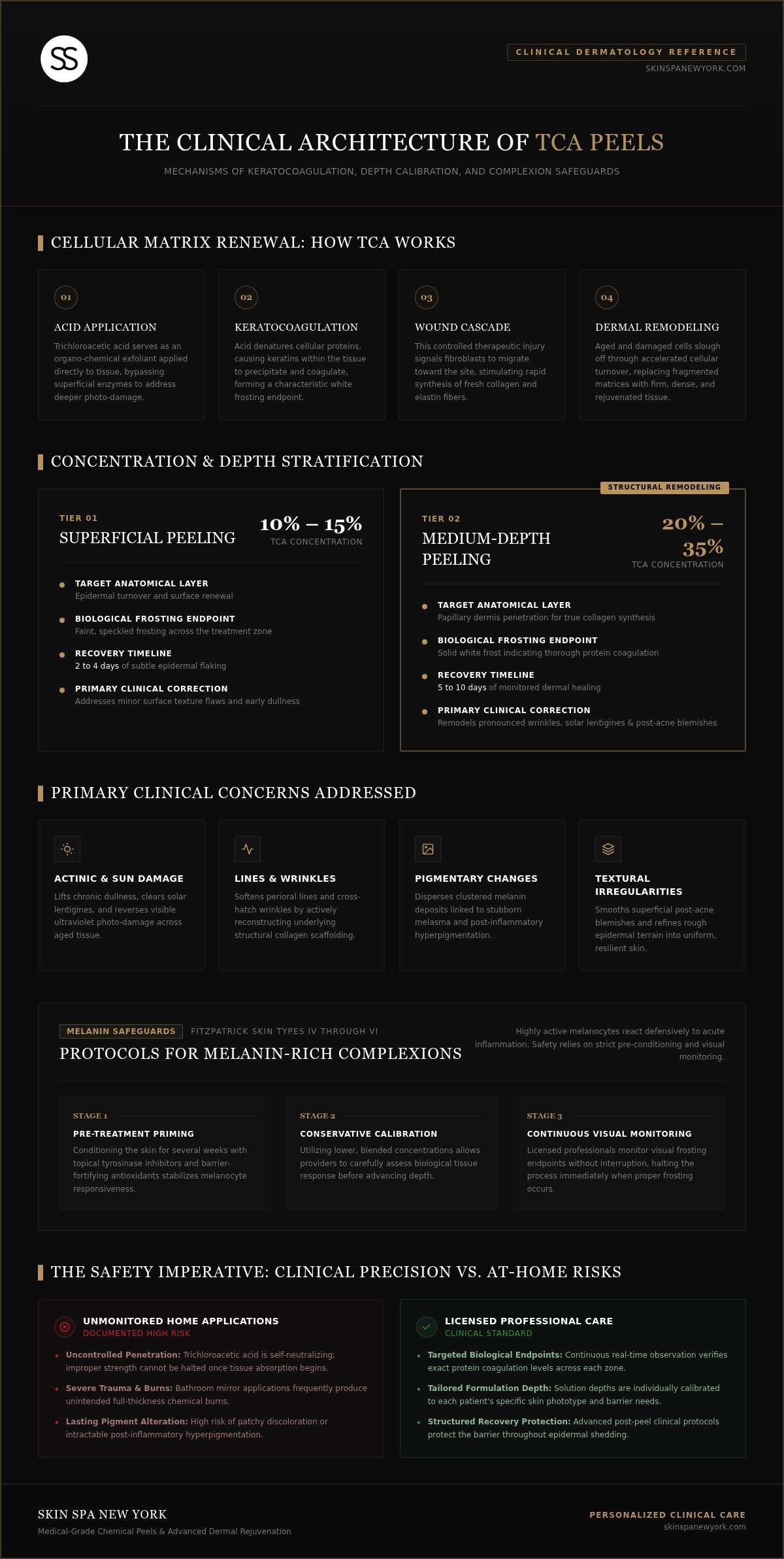
When applied to the skin, trichloroacetic acid denatures cellular proteins, causing keratins within the tissue to precipitate and coagulate. This self-neutralizing reaction forms a temporary white frost across the treatment zone, signaling that the acid has reached its intended target layer. According to standard clinical chemical peel classification and depth guidelines, this controlled injury triggers the body's natural wound-healing cascade. Fibroblasts migrate into the area, rapidly ramping up the production of new collagen and elastin fibers. While superficial applications concentrate on epidermal turnover, deeper protocols initiate genuine dermal remodeling, replacing fragmented structural matrices with fresh, dense tissue.
Primary Skin Concerns Addressed by TCA Formulations
Because trichloroacetic acid targets both superficial and intermediate tissue layers, it provides transformative results for complex concerns that standard topical skincare simply cannot resolve. Every patient receives a tailored protocol designed for their specific complexion:
- Actinic and Sun Damage: Lifting chronic dullness, clearing solar lentigines, and reversing visible ultraviolet exposure.
- Fine Lines and Etched Wrinkles: Softening perioral lines and cross-hatch wrinkles by rebuilding underlying dermal scaffolding.
- Pigmentary Changes: Dispersing clustered melanin deposits caused by melasma and post-inflammatory hyperpigmentation.
- Textural Irregularities: Smoothing superficial post-acne blemishes and rough epidermal terrain.
Accelerated cellular turnover gradually sloughs away aged, irregular cells over several days. What emerges beneath the surface is noticeably firmer, refined, and naturally radiant skin.
Concentrations and Depth: Selecting the Appropriate Intensity
Selecting the right formulation for a tca peel requires balancing therapeutic depth with clinical safety. Because trichloroacetic acid does not require an external neutralizing agent, the intensity of the treatment depends entirely on concentration, application technique, and the biological characteristics of the patient's skin. Understanding these parameters ensures predictable, radiant rejuvenation without unnecessary trauma.
Superficial vs. Medium-Depth Acid Strengths
Formulations generally fall into distinct clinical tiers. Light concentrations of 10% to 15% focus on epidermal renewal. They produce faint, speckled frosting and address minor texture flaws with two to four days of subtle flaking. In contrast, 20% to 35% concentrations penetrate through the papillary dermis to stimulate true collagen synthesis. As highlighted in the Mayo Clinic chemical peel overview, medium-depth peeling produces a solid white frost, representing thorough protein coagulation that requires rigorous monitoring by licensed professionals to ensure uniform penetration and five to ten days of healing.
Fitzpatrick Skin Typing and Pigmentation Safeguards
A successful peel hinges on respecting individual skin phototypes. Melanin-rich complexions, classified under Fitzpatrick skin types IV through VI, possess highly active melanocytes that react defensively to acute thermal or chemical inflammation. Applying aggressive concentrations without preparation can trigger stubborn post-inflammatory hyperpigmentation or patchy discoloration. Safe clinical care protects against these risks through meticulous protocols:
- Pre-Treatment Priming: Conditioning the skin for several weeks with topical tyrosinase inhibitors and barrier-fortifying antioxidants stabilizes melanocyte activity.
- Conservative Acid Calibration: Utilizing lower, blended concentrations allows providers to monitor tissue response before advancing to deeper depths.
- Monitored Application: Licensed professionals observe visual endpoints continuously, halting the process the moment proper frosting occurs.
Skin renewal should always be tailored to your unique baseline. If you're ready to explore a customized resurfacing plan designed around your specific complexion, consider scheduling a consultation with the specialists at Skin Spa.
Clinical Application vs. At-Home Risks: The Safety Imperative
The accessibility of direct-to-consumer chemical solutions online has fostered a misconception that medical-grade resurfacing can be safely managed from a bathroom mirror. Attempting a self-administered tca peel presents severe hazards. Trichloroacetic acid isn't a standard exfoliating serum; it's a potent, non-buffered agent that immediately coagulates living cellular proteins upon contact.
The Hazards of Unsupervised At-Home Acid Peels
Unregulated peel solutions sold online frequently lack rigorous quality testing, resulting in fluctuating acid purities and volatile pH levels. Without professional application tools and clinical lighting, liquid acids pool easily into natural facial creases, such as the nasal folds and the corners of the mouth.
Because trichloroacetic acid self-neutralizes through cellular destruction rather than a quick water wash, an uneven application can spark serious complications:
- Chemical Burns: Uncontrolled dermal penetration that destroys tissue past the intended regenerative threshold.
- Prolonged Erythema: Persistent vascular flushing and skin hypersensitivity that can linger for months.
- Irreversible Scarring: Thickened or atrophic marks caused by poor application mechanics and improper barrier repair.
- Severe Pigment Damage: Uneven hyperpigmentation or permanent loss of color that proves exceedingly difficult to reverse.
Online video tutorials simply can't replace the tactile diagnostic instincts acquired through years of aesthetic training.
The Advantage of Treatment by Licensed Professionals
Undergoing a professional tca peel in an accredited clinical setting transforms this potent compound into a predictable, highly effective treatment. Licensed professionals carefully assess your barrier resilience, medical background, and skin health before selecting an active peel protocol.
During the procedure, your practitioner degreases the stratum corneum with specialized prep solutions to eliminate uneven surface lipids. As the acid is laid down, your provider tracks the subtle visual shift from light erythema to targeted frosting, calibrating application passes across distinct facial contours. This level of precision protects sensitive areas, such as the delicate orbital rim, while ensuring an even depth of penetration.
Receiving personalized care in a controlled environment gives every patient complete peace of mind. Clinical oversight removes hazardous guesswork, ensuring your rejuvenation path is safe, structured, and deeply restorative.
The Treatment Journey: Preparation, Procedure, and Recovery Protocol
Achieving radiant results from a tca peel depends just as much on disciplined preparation and diligent recovery as it does on the clinical application itself. Resurfacing is an active biological journey. When approached with structured care, the path from initial consultation to final reveal feels predictable, restorative, and remarkably rewarding.
Pre-Treatment Conditioning and Priming Protocols
Proper skin preparation begins two to four weeks before your appointment. Priming strengthens the moisture barrier and conditions melanocytes to prevent erratic post-treatment responses. Licensed professionals routinely guide each patient through essential preparatory guidelines:
- Melanin Regulation: Applying topical tyrosinase inhibitors, such as azelaic acid or kojic acid, calms pigment pathways.
- Suspending Active Exfoliation: Discontinuing retinoids, glycolic acid, salicylic acid, and rough mechanical scrubs five to seven days prior prevents unintended deep penetration.
- Rigorous Barrier Hydration: Incorporating ceramide-rich moisturizers creates a hydrated cellular base for even acid distribution.
- Strict Sun Avoidance: Daily application of broad-spectrum SPF 30+ prevents baseline UV inflammation before treatment day.
Navigating the Recovery Phase and Barrier Protection
During the procedure, you will feel a noticeable warming sensation as the solution is applied, which quickly settles once the acid finishes its targeted pass. The true regenerative work begins over the subsequent week. Recovery follows a predictable cadence that requires gentle patience:
- Days 1 to 2: Skin feels tightened and may display faint erythema, often taking on a mild bronzed hue as compromised surface cells prepare to separate.
- Days 3 to 5: Visible flaking begins, typically starting around high-movement areas like the mouth and nose before expanding outward.
- Days 6 to 10: Deeper shedding concludes, unveiling smooth, luminous tissue beneath.
Resist any temptation to pick, pull, or mechanically scrub peeling skin. Forcibly detaching shedding sheets exposes immature dermal layers, risking redness and prolonged discoloration. Cleanse exclusively with gentle, non-stripping washes, layer barrier-restorative balms generously, and shield your face from direct sunlight.
If you want to refresh your complexion with expert guidance every step of the way, book your chemical peel consultation with Skin Spa today.
Personalized Clinical Peels and Advanced Rejuvenation at Skin Spa
While an intensive tca peel provides powerful structural renewal, lasting skin health requires an intentional, individualized strategy. Skin Spa New York approaches skin health through tailored clinical pathways rather than rigid, generalized formulas. With premier medical spa locations across New York, Boston, and Miami, our licensed professionals design targeted regimens that restore clarity, refine uneven texture, and elevate your natural radiance safely.
Customized Chemical Peels and Clinical Exfoliation
Every complexion presents distinct biological needs, from sensitive barriers recovering from seasonal dryness to resilient skin holding stubborn sun damage. At Skin Spa New York, we offer sophisticated exfoliation modalities, including customized facial treatments and medical-grade PCA peels. Our licensed professionals perform thorough diagnostic skin evaluations prior to any application, selecting peeling agents that target specific concerns without overwhelming the epidermal barrier.
These curated formulations combine active acids with soothing corrective blends to stimulate vibrant cellular renewal. By calibrating the intensity of your treatment to your personal skin history, our practitioners ensure you achieve a luminous glow while minimizing unexpected downtime.
Integrating Advanced Modalities for Comprehensive Results
True dermal transformation often happens when chemical resurfacing works alongside cutting-edge clinical technologies. Depending on your aesthetic goals, our specialists may complement chemical peels with complementary therapies within a structured, long-term plan:
- Microdermabrasion: Gently sweeps away compacted surface cells prior to targeted treatments to maximize active absorption.
- Laser Genesis: Delivers non-invasive thermal energy into the upper dermis to stimulate collagen, calm diffuse redness, and smooth fine lines.
- Radiofrequency Microneedling: For deeper laxity and structural remodeling, advanced treatments like Morpheus8 NYC remodel subdermal tissue to rebuild firmness from within.
A successful rejuvenation journey begins with an honest, thoughtful conversation about your skin. We invite you to visit our comfortable sanctuaries in New York, Boston, or Miami to discover a personalized aesthetic plan curated specifically for your skin.
Elevate Your Skin Health With Clinical Precision
True dermal transformation requires a deliberate balance between biological respect and clinical precision. While a professional tca peel offers profound regenerative benefits by smoothing persistent texture and clearing deep pigment, optimal results rely on expert formulation calibration, diligent barrier priming, and guided aftercare. Stepping away from unpredictable at-home methods ensures your skin heals evenly, safely, and beautifully.
With over two decades of trusted aesthetic expertise across New York, Boston, and Miami, Skin Spa is dedicated to delivering personalized care tailored to your individual skin goals. Every treatment is administered exclusively by licensed professionals utilizing advanced technologies and medical-grade formulations. Whether you're addressing stubborn photodamage or seeking a comprehensive resurfacing plan, our team provides the attentive support every patient deserves.
Your path to a smoother, healthier complexion begins with an individualized evaluation. Book your personalized skin rejuvenation consultation at Skin Spa and step forward into luminous, lasting radiance.
Frequently Asked Questions
How long does peeling typically last after receiving a professional TCA peel?
Visible flaking usually begins on day three and concludes around day seven to ten following a professional tca peel. Initial tightness and mild bronzing develop over the first forty-eight hours before active sloughing commences around the mouth and nose. Patients should never pull or pick shedding skin prematurely, as allowing the tissue to separate naturally protects the fresh epidermal layer underneath and guarantees a smooth, even recovery.
Can patients with sensitive or deeper skin tones safely undergo a TCA peel?
Yes, patients with sensitive complexions or deeper Fitzpatrick skin tones can safely receive treatment when protocols are properly adjusted. Higher melanin levels require careful clinical priming with pigment inhibitors alongside lower, blended acid percentages to prevent post-inflammatory hyperpigmentation. Licensed professionals in New York, Boston, and Miami tailor application depth to each individual barrier, prioritizing steady, safe rejuvenation over aggressive peeling.
What is the primary difference between a professional TCA peel and an at-home peeling kit?
Professional treatments provide medical-grade formulations applied under controlled clinical monitoring, whereas at-home kits feature volatile, unverified acid strengths without safety oversight. Trichloroacetic acid triggers immediate protein coagulation upon skin contact. Without a trained specialist tracking frosting endpoints and facial contours, DIY applications present high risks of chemical burns, prolonged redness, and permanent scarring that require medical intervention to correct.
Does a clinical TCA chemical peel treatment hurt during application?
Most patients feel a moderate, brief warming or prickly sensation during active application, rather than sharp pain. This feeling peaks within two to three minutes as the acid reaches its biological endpoint and denatures surface proteins. Providers often use targeted cooling fans to ensure complete comfort throughout the procedure. Once the solution self-neutralizes, any intense warmth quickly subsides into a mild sensation similar to a light sunburn.
How many treatment sessions are usually required to see noticeable improvement in skin texture?
Many patients notice brighter tone and softer texture after a single superficial session, though deeper textural correction typically requires a structured series. Addressing stubborn sun spots, acne blemishes, or fine lines usually involves two to four treatments spaced several weeks apart. Your provider will evaluate your progress between appointments, ensuring your moisture barrier remains strong while collagen remodeling continues to unfold.
What skincare ingredients must be avoided before and after a chemical peel?
You should pause direct exfoliating actives, including retinoids, glycolic acid, salicylic acid, and benzoyl peroxide, five to seven days before and after your peel. Physical scrubs and astringent toners must also be set aside. Post-treatment care focuses entirely on gentle hydration, restorative ceramides, and broad-spectrum mineral sunscreens to support barrier repair and prevent irritation during the critical cellular regeneration stage.
How soon after a professional chemical peel can a patient apply makeup?
Patients should wait until active shedding has fully finished, which typically takes seven to ten days, before applying standard cosmetic makeup. Applying foundation or powders over peeling skin introduces bacteria to vulnerable tissue, delays cellular shedding, and emphasizes flaking. Once the skin completely heals and feels comfortable, mineral-based formulas can be reintroduced alongside a daily routine of hydrating moisturizer and non-negotiable sun protection.
