

Fixing uneven eyebrows after Botox often starts with patience: results develop gradually over one to two weeks, and early asymmetry may settle as both sides respond. Wait until about two weeks after treatment for a proper assessment. If the imbalance persists, a qualified injector may recommend a small corrective injection based on your brow position and facial muscle movement.
An eyebrow that suddenly looks higher or lower can feel unsettling, especially when you expected a subtle, balanced result. This guide explains why brows may look uneven after Botox, what changes to expect as the treatment takes effect, how long an imbalance may last, and which options may help. You’ll also learn when to seek an assessment and why adding more product too soon may not be the right move.
Key Takeaways
- Give Botox time to take effect: brow position can continue changing over the first two weeks, so an early difference may not be the final result.
- An overarched brow and a dropped brow have different causes, so the area and pattern of imbalance matter when considering correction.
- Additional injections may help address persistent asymmetry, but timing and placement are important to avoid treating a difference that may settle on its own.
- Botox-related brow changes typically improve as the treatment wears off; seek an assessment if drooping persists or concerns you.
- Learn how personalized Botox Cosmetic care at Skin Spa New York can support a thoughtful assessment of your brow goals.
Why Do You Have “Spock Eyebrows” After Your Botox Treatment?
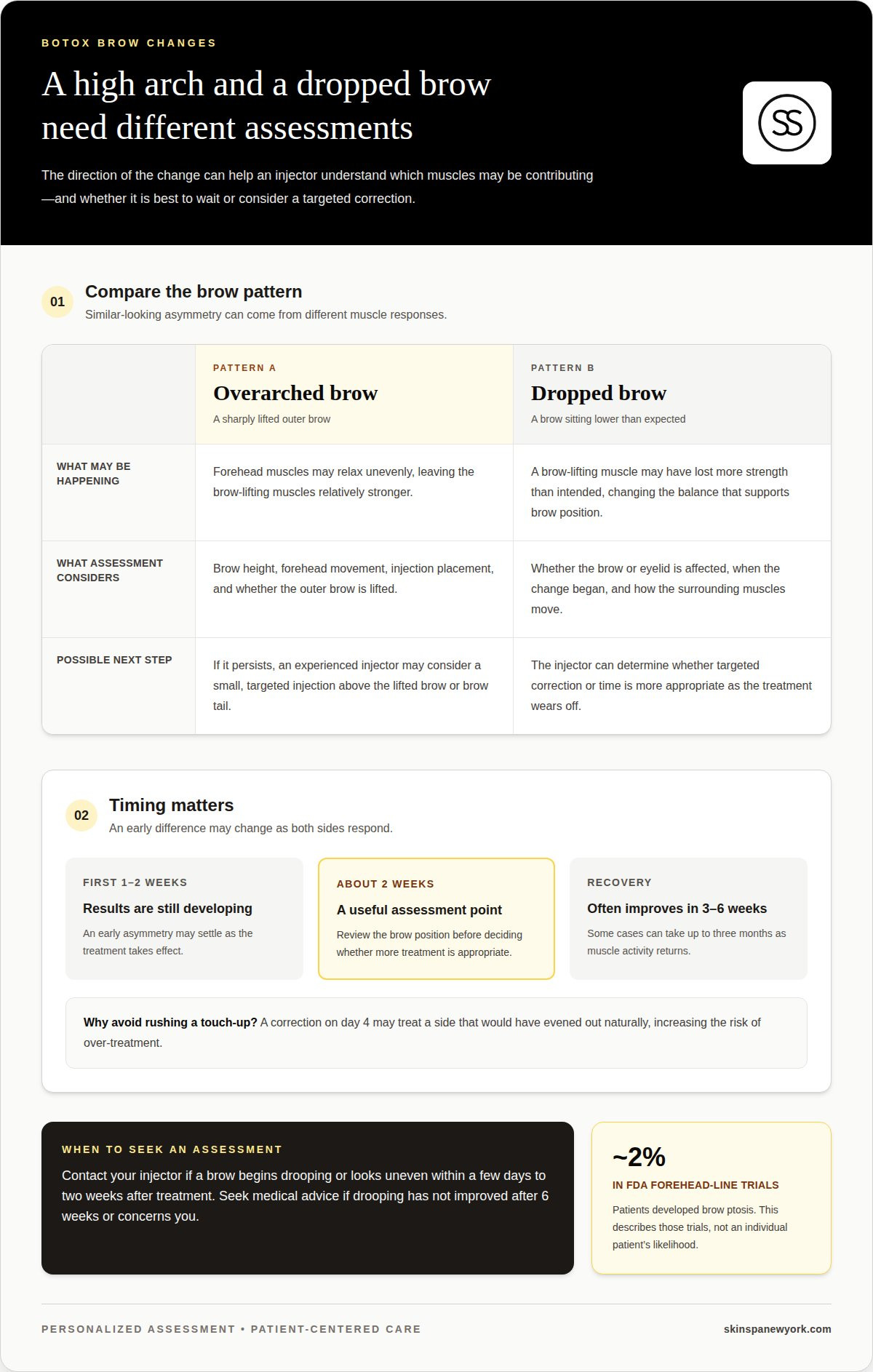
A sharply arched outer brow can appear when forehead muscles relax unevenly, leaving the brow-lifting muscles relatively stronger. Botox results develop over one to two weeks, so an early difference may change as both sides respond.
Injector Assessment and Consultation
An injector assessment compares brow height, forehead movement, and the timing of the change before considering correction. This matters because a high outer arch and a low brow can reflect different muscle patterns, and treating the wrong area may deepen the imbalance. Dr. Dean Kane recommends consulting an experienced injector who understands facial muscle action. Bring the treatment date and explain when you first noticed the change.
Injection Placement and Diffusion
Injection placement affects which muscles relax, while slight diffusion into adjacent muscles can contribute to an uneven expression. For example, if the forehead muscles that lower the brow relax more on one side, the upward pull may become more visible on that side. The FDA label directs forehead injections at least 2 cm above the eyebrow. Assessment considers placement, muscle strength, and whether drooping or an overarched tail is present.
Corrective Injections and Natural Recovery
Corrective injections use additional Botox in selected muscles to rebalance the brow, while natural recovery allows the original treatment to settle. A Spock brow may be brought down within a couple of days after an injector places additional Botox or Dysport above the lifted brow. A small injection above the brow tail may also improve symmetry in some cases. The right placement depends on the direction of the imbalance.
When should I contact my injector about uneven eyebrows after Botox? Contact your injector if a brow begins drooping or looks uneven within a few days to two weeks after treatment. An assessment around two weeks can help distinguish a developing result from persistent asymmetry.
When is it safe to get more Botox after an uneven result? The result should generally be assessed at about two weeks before deciding on more Botox. A touch-up on day 4 may treat a side that would have evened out naturally, raising the risk of over-treatment.
Is Botox touch-up for eyebrow asymmetry included in the original treatment price? There’s no universal rule that a touch-up is included. The price depends on the case and is provided after a quote request, with the correction area and treatment plan among the factors.
A surgical brow lift addresses a different concern and doesn’t rebalance recently injected muscles. If the arch remains after the two-week assessment, an experienced injector can determine whether targeted correction or time is the more appropriate next step.
How Long Does Botox Eyebrow Droop Last?
Botox-related eyebrow droop often settles within 3 to 6 weeks, though full recovery can take up to three months. The timing depends on how the treated muscles respond and how quickly the product wears off.
Forehead Muscle Anatomy and Brow Balance
The frontalis muscle lifts the eyebrows, while nearby muscles help lower and shape them. Botox changes that balance by reducing activity in selected muscles. If one side relaxes more strongly, or a brow-lifting muscle loses more strength than intended, the brows can sit at different heights. Individual anatomy matters: even a difference of one or two units can have different effects from one patient to another.
Strategic placement aims to preserve enough frontalis activity for comfortable brow elevation while softening the targeted movement. The injector considers your resting brow position, muscle movement, and facial symmetry before choosing dose and placement. These adjustments aim to reduce the chance of drooping, but natural differences between the two sides of the face still shape the result.
How Long Drooping Can Last
Botox-related brow droop usually improves within 4 to 6 weeks as the effect begins to wear off. In some cases, recovery takes up to three months, as the muscles gradually regain activity. A brow change may peak around two weeks, so its appearance early after treatment doesn’t necessarily predict its eventual position.
About 2% of patients in FDA clinical trials for forehead lines developed brow ptosis. That figure describes those trials, not an individual patient’s likelihood. If drooping hasn’t improved after 6 weeks, seek medical advice. An assessment considers whether the eyelid or brow is affected, when the change began, and whether other symptoms are present.
Dosage, Placement, and Aftercare
To support symmetry, an injector evaluates how the frontalis and surrounding muscles move together, rather than treating each brow as an isolated feature. A carefully chosen dose and placement can help maintain balance. For older patients, clinical guidance recommends placing injections at least 4 cm above the brow. The appropriate plan still depends on facial anatomy and the treatment area.
What should I avoid doing after Botox to prevent eyebrow unevenness? For the first 4-6 hours, avoid rubbing the injection area, lying flat, or intense activity. Avoid strenuous exercise and facial massage for at least twenty-four hours after treatment, and follow your injector’s specific aftercare advice.
Botox diffusion to adjacent muscles
Botox can diffuse slightly into nearby muscles and partially relax them, changing facial movement. Around the forehead, this may alter how the brows lift or settle. For example, relaxation near one brow can make its movement look different from the other side. The resulting asymmetry reflects how treated and adjacent muscles work together, not simply where wrinkles appear at rest.
Differences in muscle strength can also shape the result. One side of the forehead may naturally move more, while the other contributes less lift. If Botox affects both sides similarly, their visible responses can still differ because their starting movements differ. An injector assesses both brows in motion, including how they rise when you lift your forehead and settle when relaxed.
The timing of the effect offers useful context. Botox usually begins to soften treated muscles 3 to 5 days after injection, while the two sides may respond at different rates. A brow that looks uneven during this period may reflect developing effects rather than a stable outcome. Compare expressions at rest and during movement, such as raising your brows, instead of judging one photograph alone.
Facial exercise isn’t a dependable way to reverse diffusion or restore a particular muscle’s strength. Repeatedly raising your brows may reveal differences in movement, but it doesn’t selectively undo Botox’s effect. For instance, exercising the side that moves more can’t precisely relax it or restore the opposite side. Don’t massage your face to try to move the product; follow your injector’s aftercare instructions instead.
Strategic muscle targeting begins by identifying which movement creates the imbalance. An overarched outer brow, for example, differs from a brow that sits low across the forehead. An injector considers each brow’s position and direction of movement, along with nearby muscles, before deciding whether an adjustment makes sense. The aim is to address the contributing muscle pattern, not chase every small difference.
At an assessment, describe when the change appeared and whether it shifts with expression. A dated photo from before treatment and a current photo can help show the difference. Your injector can then distinguish a changing response from a persistent pattern and decide whether observation or correction is appropriate. This assessment is more useful than trying to counteract unevenness with exercise or pressure at home.
Common causes of eyebrow asymmetry
Uneven brows after Botox can reflect a treatment effect, natural facial differences, or both. Understanding these possibilities helps clarify what changed and what an assessment should focus on.
Botox-Related and Natural Asymmetry
Natural asymmetry is a difference in brow height or movement that appears before treatment, while Botox-related asymmetry develops after injections. Comparing a pre-treatment photo with a current image can help show whether one brow’s position or movement has changed. Use similar expressions and angles, since a raised brow in one image can create a false impression of imbalance. This distinction matters because your natural facial anatomy informs how the result is assessed.
How can I tell Botox-related brow asymmetry from natural facial asymmetry? Compare images taken before and after treatment, ideally with your face relaxed and then your brows raised. A difference already visible before treatment points to natural asymmetry; a new change after injections may reflect the treatment’s effect.
Worsened Asymmetry and Eyelid Drooping
Botox can make existing asymmetry more noticeable if the two sides respond differently, and it can cause brow or eyelid drooping. The FDA clinical trials for forehead lines reported brow ptosis in about 2% of patients. That figure concerns brow droop, not every kind of unevenness, and an eyelid that appears lower is distinct from a brow sitting lower.
Can Botox make eyebrow asymmetry worse or cause a drooping eyelid? Yes. Botox can accentuate a pre-existing difference or cause brow ptosis; eyelid drooping can also occur. If your eyelid seems lower after treatment, contact your injector and describe when the change began.
Several causes can overlap. You might begin with a naturally higher left brow, then notice the right brow appears lower as treatment effects develop. The change can also relate to how forehead and surrounding muscles move together. An injector assesses your resting position and expression, rather than relying only on how the brow looks in one still image.
Timing helps frame the assessment. Brow changes often become noticeable 3-7 days after treatment, as the two sides take effect at different rates. Late-onset eyebrow droop has also been reported up to two weeks after injection. A difference appearing during this period should be described alongside its onset and whether it changes during facial movement.
Other procedures or changes in expression can complicate comparisons, so note the date of each treatment and use photographs taken under similar conditions. For example, compare relaxed brows in both images, then compare raised brows. If your eyelid, rather than your brow, seems lower, describe that clearly when contacting your injector. These details help clarify which features appear uneven.
Uneven eyebrow position after Botox
After Botox, eyebrow position can change as forehead muscles respond, and the two sides may not move in perfect synchrony. Focus on the pattern: one brow may sit higher, the outer tail may rise, or one side may appear lower. These are distinct outcomes. Identifying which part looks altered helps clarify whether the concern involves brow position, eyelid ptosis, or both.
Early timing offers useful context. Unevenness is often most noticeable from days 3 to 7, while each side responds at a different rate. Most unevenness visible on day 3 resolves within 10 to 14 days after injection without intervention. A daily series of photos taken with the same expression and lighting can make changes easier to assess than checking a single mirror image.
Compare both sides at rest and during movement. For example, note whether the outer brow rises only when you lift your forehead or remains visibly higher while relaxed. A difference that changes with expression suggests a movement pattern worth describing to your injector. Record when it first appeared and whether it’s changing; late-onset eyebrow ptosis has been reported up to two weeks after injection.
Timing also matters before considering another injection. A Botox result should be assessed at about two weeks after injection before persistent asymmetry is considered for correction. A touch-up on day 4 can add treatment to a side that would have evened out on its own, creating a risk of over-treatment. Waiting for the result to develop gives the provider a clearer view of the brow’s position.
For patients considering fixing uneven eyebrows after botox, an experienced injector can evaluate the movement pattern and consider targeted correction after the result has developed. A small corrective Botox injection may lift a dropped eyebrow by 1 to 2 mm. For a raised outer tail, a small amount above the brow may improve symmetry in some cases. The choice depends on whether the brow is high, low, or uneven only during expression.
An eyelid that appears lower is different from a low brow. Prescription eye drops can lift a dropped eyelid by about 1 to 3 mm, but they don’t lift the eyebrow. Botox-related eyelid droop often settles within 3-4 weeks. Describe whether the eyelid itself looks lower when contacting your provider, since that distinction affects the assessment.
If the position hasn’t changed by 6 weeks, seek medical advice about the next step. Botox effects typically wear off over 3 to 4 months, so temporary asymmetry can improve as muscle activity returns. The practical takeaway for fixing uneven eyebrows after botox is to document the specific position, allow time for the result to develop, and base correction on an assessment rather than an early impression.
Skin Spa New York: Botox Cosmetic
Skin Spa New York offers Botox Cosmetic for patients considering treatment or seeking an assessment of brow concerns. If your brows look uneven after injections, share when the change began, whether it is shifting, and whether your eyelid or brow itself looks lower. These details help frame a discussion about your facial movement, treatment goals, and appropriate next steps at Skin Spa New York in New York, Boston, or Miami.
For patients considering Botox Cosmetic, an individualized approach takes natural brow position and forehead movement into account. If you’re concerned about your results or exploring treatment, contact Skin Spa New York in New York, Boston, or Miami to discuss your needs.
Choose Your Next Step With Confidence
Your next step can be a focused conversation about what you’re noticing and the outcome you want. A thoughtful approach to fixing uneven eyebrows after Botox starts with your individual brow movement, treatment history, and concerns, rather than a rushed decision to add more product. Bring those details to Skin Spa New York in New York, Boston, or Miami for an assessment focused on your goals.
Skin Spa New York also offers Laser Hair Removal, Customized Facial treatments, and Microneedling for patients exploring other aesthetic services in New York, Boston, and Miami. Each addresses a different concern, so your care can stay focused on what matters to you.
If you’re ready to discuss your brow concerns or treatment goals, contact Skin Spa New York. Take the next step at a pace that feels comfortable, with a clear understanding of your options.
Frequently Asked Questions
How Can It Be Fixed?
An injector can assess the brow pattern and decide whether targeted correction or time is appropriate. For example, a high outer brow may call for a different approach than a brow that sits low. Avoid trying to correct the position with pressure or self-massage. If an eyelid appears lower, mention that specifically, since eyelid droop and brow position are distinct concerns.
What Is Uneven Botox?
Uneven Botox describes a difference in how facial areas look or move after treatment, such as one brow appearing higher or moving less than the other. It doesn’t identify a single cause. You might notice asymmetry only while raising your forehead or see a difference at rest. Describing the specific movement helps your injector assess what changed.
Are Heavy or Low Eyebrows After Botox Normal?
Heavy or low-feeling brows can occur after forehead Botox, but the sensation alone doesn’t show whether the brow or eyelid has shifted. Notice whether the brow itself sits lower, the eyelid seems lower, or lifting your forehead feels different. If the change concerns you, tell your injector when it began and whether it affects one or both sides.
Can one side of Botox kick in faster than the other?
Yes. The two sides can begin responding at different rates, so a temporary difference may appear before the full result develops. For example, one brow may look less mobile while the other still moves normally. Track changes with photos taken in similar lighting and expressions. Comparing them can help distinguish a developing effect from a persistent difference.
How Common Is Brow Drooping After Botox?
About 2% of patients in FDA clinical trials for forehead lines developed brow ptosis. That figure refers to brow drooping in those trials, not every type of uneven brow appearance or every treatment setting. It also can’t determine the cause of an individual patient’s change. If a brow looks newly lower after treatment, note when it appeared and describe the change to the injector.
How Long Does It Take to Recover from Eyebrow Ptosis?
Botox-related eyebrow ptosis often improves within 4 to 6 weeks, though recovery can take up to three months. The timing varies with how the treated muscles regain activity as the effect fades. If the droop hasn’t improved after 6 weeks, seek medical advice. Describe whether the brow or eyelid appears lower, as that distinction helps clarify the concern.
Is Brow Ptosis from Botox Permanent?
Botox-related brow ptosis is generally temporary because the treatment’s effect wears off over time. Botox effects typically wear off over 3 to 4 months, and brow movement can return as muscle activity recovers. A persistent or worsening change deserves medical advice, especially if the eyelid seems affected. Tell the clinician when the droop began and how its position has changed.
Why can Botox make eyebrows uneven or asymmetrical?
Botox can create visible asymmetry when the two sides respond differently or nearby muscles are partially relaxed. Natural differences in facial anatomy and muscle strength can also influence how each brow moves. For example, if your brows were already at different heights, you may notice that contrast more after treatment. An assessment considers both resting position and movement.
