

The most visible Botox injector isn’t automatically the right fit. To learn how to find a good Botox injector in Boston, look for relevant medical credentials and aesthetic training, consistent before-and-after photos, and clear, thoughtful communication during a consultation. Reviews and personal recommendations can help you create a shortlist, but your comfort and confidence in the provider matter, too.
It’s reasonable to want natural-looking results and a treatment experience that feels informed, not rushed. A thorough consultation should give you room to discuss your goals, understand the proposed approach, and hear about potential outcomes and risks before deciding. Botox results take about two weeks to appear, so the provider should also explain what to expect as they develop.
This guide shows you how to assess an injector’s qualifications, experience, results, and follow-up, and how to discuss Botox and other neurotoxins. Use it as a practical framework for comparing options in Boston and choosing care that aligns with your priorities.
Key Takeaways
- Compare an injector’s medical credentials, aesthetic training, and hands-on experience before choosing.
- Review before-and-after photos for consistent angles, expressions, and lighting to better assess results.
- Use the consultation to discuss your goals, the proposed treatment, potential outcomes, and risks without feeling rushed.
- Ask which neurotoxin products are used and how the injector plans to assess your results after treatment.
- Consider whether the provider’s communication and approach make you feel informed, comfortable, and respected as a patient.
How to find the best Botox injector?
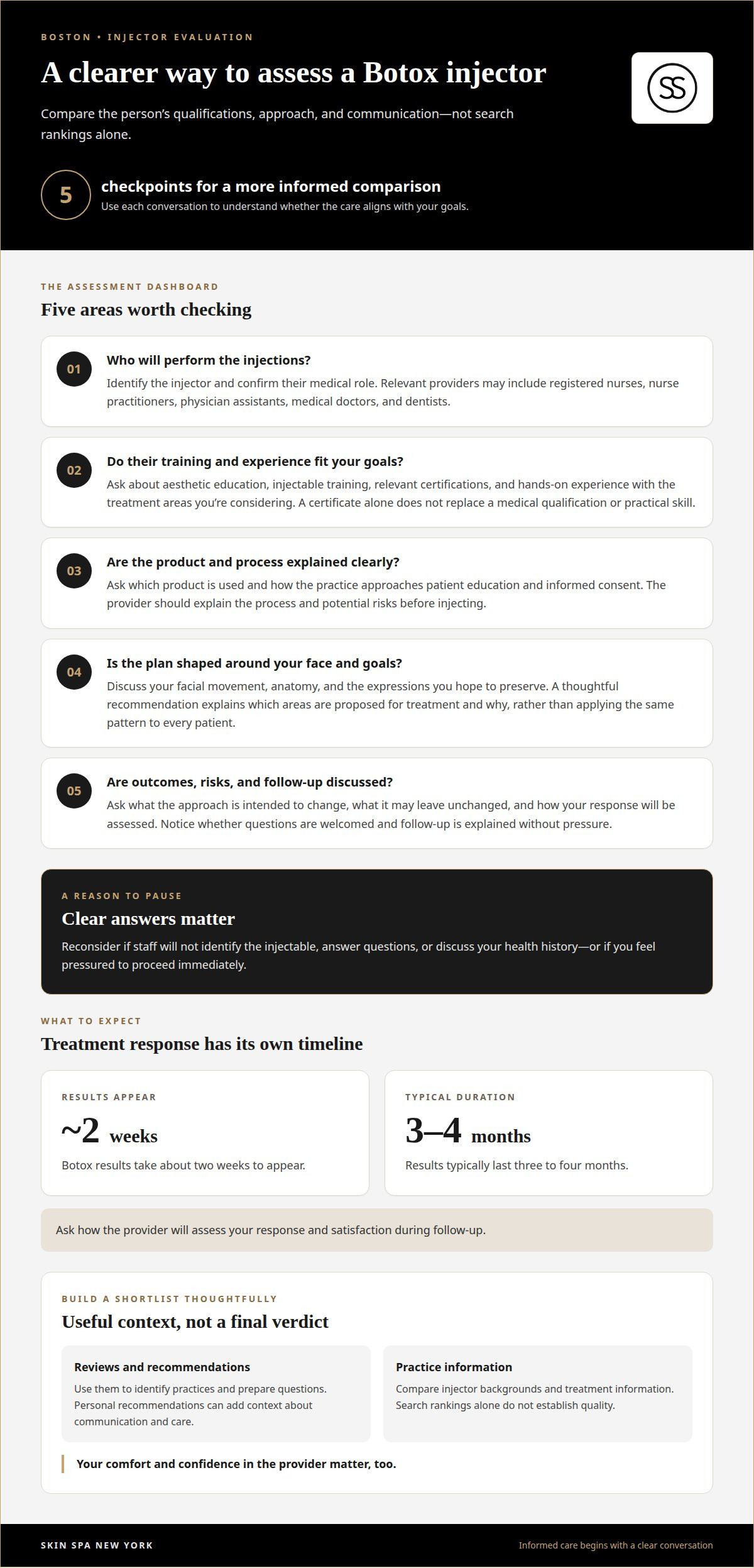
To learn how to find a good Botox injector in Boston, compare the practitioner’s qualifications, treatment approach, and communication, not just search rankings. Reviews and recommendations can help you build a shortlist; a consultation lets you assess whether the care suits your goals.
-
Locate Reputable Boston-Area Clinics
Look for aesthetic medical practices in Boston and nearby neighborhoods, then compare injector backgrounds, patient reviews, and treatment information. Personal recommendations can add useful context, especially when they describe clear communication and thoughtful care. Search rankings alone don’t establish quality. Use practice information to identify the injector and prepare questions before booking a consultation.
-
Compare Injector Roles and Expertise
Identify who will administer your treatment and ask about their medical credentials, aesthetic training, and hands-on experience. A dermatologist, plastic surgeon, or nurse injector may each have relevant experience; assess the individual’s background rather than relying on a title alone. Ask how their training relates to the facial areas you want treated and whether they understand your goals before recommending an approach.
-
Screen for Unsafe Clinics and Products
Ask which product the practice uses and how it approaches patient education and informed consent. Before injecting, a provider should explain the process and potential risks. Be cautious if staff won’t identify the product, answer questions, or discuss your health history. Pressure to proceed immediately or unclear information about the injectable are reasons to pause and reconsider.
-
Assess Facial Anatomy and Treatment Planning
Bring your goals to the consultation and ask how the proposed plan accounts for your facial movement and anatomy. A thoughtful recommendation should explain which areas are being treated and why, rather than applying the same pattern to every patient. For example, discuss what you want softened and which expressions you hope to preserve. This helps connect treatment choices to your individual features.
-
Clarify Outcomes, Risks, and Follow-Up
Ask the injector to describe possible outcomes and side effects, and how they’ll assess your response after treatment. A useful explanation covers what the proposed approach is intended to change, what it may leave unchanged, and what to do if you have concerns. As you look for a good Botox injector in Boston, notice whether the provider welcomes questions and explains follow-up clearly, without pressuring you to proceed.
Checking injector qualifications, education, and experience
Review the injector’s medical credentials, aesthetic education, and hands-on experience before comparing treatment approaches. These details help you assess whether their background matches your goals and concerns about signs of aging.
-
Verify Credentials and Education
Start by identifying the professional who will perform your injections and confirming their medical role. Botox injectors include licensed registered nurses, nurse practitioners, physician assistants, medical doctors, and dentists. Ask about aesthetic education, injectable training, and relevant certifications; a certificate alone doesn’t replace a medical qualification or practical skill.
Then ask how the injector keeps their knowledge current. Botulinum treatments require more than familiarity with a product name: training should cover injection techniques, facial anatomy, and patient assessment. Nurses or physician assistants injecting under a physician’s guidance should complete a credible injectable training program. Look for clear answers about who provides guidance and how the injector’s education relates to your planned treatment.
-
Assess Experience and Anatomical Knowledge
Ask how long the practitioner has performed injectable treatments and how many procedures they have completed. A meaningful answer describes the injector’s experience with the treatment areas you’re considering, rather than relying on a broad claim of expertise. Ask how they assess your facial movement and anatomy before choosing injection sites.
For example, someone concerned about forehead lines should hear how the injector evaluates expression and muscle movement, not simply receive a fixed plan. Strong anatomical knowledge supports thoughtful treatment planning and helps the injector explain why an approach suits your features. Ask which outcomes they aim to preserve, such as natural facial expression, and how they adapt plans for different patients.
-
Look for Focused Expertise and Approach
Compare the injector’s specific aesthetic focus with your priorities. A board-certified plastic surgeon, dermatologist, or oculoplastic surgeon with specialized training in injectable techniques and products may bring focused expertise. Other licensed medical professionals can also have relevant experience, so consider training and practice alongside professional title.
Ask how the injector approaches concerns such as frown lines or signs of aging around the eyes. Their explanation should connect your goals with a personalized plan, not promise identical results for every patient. Also ask whether they continue professional training as techniques evolve. A careful, direct response helps you judge whether their experience and treatment philosophy fit your needs.
Recognizing realistic results and photo manipulation
Botox results generally take about two weeks to appear and typically last three to four months. A follow-up helps assess results and satisfaction; discuss any touch-up only after reviewing the outcome.
-
Review Before-and-After Photos Critically
Review each before-and-after pair under similar conditions. Check whether the camera angle, facial expression, and lighting appear consistent. A relaxed forehead in one image and a raised brow in another can make the difference look more dramatic than it is. Shadows, makeup, filters, and cropping can also change how lines and skin texture appear.
Look for several examples that show the treatment area clearly, rather than relying on one striking image. For forehead lines, compare the same person with a similar brow position in both photographs. Notice whether the result looks balanced across the face, not just smooth in a tightly cropped area. Ask how the images were taken if the comparison seems unclear.
Use photographs as one part of your assessment, not as proof that your result will match. Each patient’s facial movement and starting appearance differ. A transparent discussion should relate an example to your own goals and explain what the images can and can’t show.
-
Set Expectations for Natural-Looking Results
Describe what “natural” means to you before treatment. You might want softer forehead lines while keeping visible expression, or a refreshed appearance without a dramatically different look. Specific examples help the injector understand your priorities and discuss a plan suited to your facial movement.
Ask what changes the proposed treatment aims to create and what it isn’t intended to change. Botox can reduce the appearance of certain dynamic wrinkles, but it isn’t a surgical procedure and won’t address every concern about facial appearance. A realistic conversation distinguishes the treatment’s purpose from broader rejuvenation goals.
Look for consistency between the injector’s explanation and the photos they present. If every example appears heavily smoothed or dramatically altered, ask for more representative results. Your goal is to feel confident in a considered approach, not pressured to pursue a particular aesthetic.
-
Track Timing and Review Results
Evaluate your results according to the treatment timeline, not the first hours afterward. Final Botox results take about two weeks to appear, so note your concerns and compare your appearance after that period. Use similar lighting and facial expressions when taking personal photos.
At follow-up, describe what changed and what still concerns you. For example, note whether forehead movement feels different and whether the lines you targeted look softer. The injector can assess your response and discuss next steps. Botox results typically last three to four months, so keep that timeframe in mind when considering future treatment rather than expecting a permanent change.
Evaluating personal fit and communication during consultations
Use the consultation to assess whether the injector listens, explains the plan, and respects your pace. A thoughtful conversation helps you decide whether the proposed Botox treatment suits your goals and comfort.
- Schedule a consultation before deciding on treatment. Set aside time to discuss your concerns and ask how the assessment works. Bring specific examples, such as wanting to soften forehead lines while preserving expression. A consultation should include a review of your goals and facial movement, not just a quick recommendation. Notice whether the injector invites questions and responds directly.
- Notice how the injector listens. Explain what you hope to change and what you want to preserve. For example, you might want a refreshed appearance without losing natural movement. The injector should clarify your priorities before suggesting a procedure. If they redirect the discussion toward treatments you didn’t ask about, pause and ask how those suggestions relate to your stated goals.
- Assess the quality of the conversation. Ask the injector to describe the proposed approach in language you understand. You should be able to explain the plan back in your own words, including its purpose and expected outcome. If you’re also considering fillers, ask how that option relates to your concern and why it may or may not fit. Clear reasoning supports an informed decision.
- Review the practice’s communication before booking. Read patient feedback for specific descriptions of consultations, such as whether staff answered questions and explained procedures clearly. You can also review the injector’s social media interactions for clues about their communication style and whether it feels comfortable to you. Online impressions are only one part of your assessment, but they can help you prepare questions for an in-person conversation.
- Take time to decide after the consultation. A provider should give you room to consider the recommendation rather than pressuring you to buy immediately. Notice whether you leave understanding the proposed treatment, the points you still want clarified, and your next step. If you feel rushed or dismissed, don’t proceed that day. Feeling comfortable with the injector is part of choosing care that fits.
Focus on the quality of the assessment as well as the recommendation. A thorough consultation gives you a chance to consider whether the discussion addresses your concerns. Reviewing a doctor’s social media interactions may offer a sense of their personality and whether you feel a connection. Treat that impression as one part of your judgment, not a substitute for the consultation.
If the conversation leaves you feeling pressured to buy immediately, walk away rather than agreeing on the spot. Take time to consider the decision before choosing how to proceed.
Botox and other neurotoxins
Compare neurotoxin options by their approved use, the injector’s experience, and how each fits your goals. Familiarity with a product matters, but it should support a careful treatment plan, not replace an assessment of your facial anatomy.
-
Ask which products the injector uses. Botox, Dysport, Xeomin, and Jeuveau are botulinum toxin products a provider may discuss. Ask which product they recommend for your concern and why. Botox Cosmetic uses botulinum toxin type A and is injected to soften certain wrinkles, including forehead lines and lines around the eyes. Ask whether the product is FDA-approved for the intended use.
Then discuss the injector’s experience with that specific product. A clear explanation should cover how it fits your treatment plan, which area it addresses, and what outcomes to expect. Don’t assume brand names mean identical formulations or treatment approaches. Ask the injector to explain the distinctions relevant to your aesthetic goals in plain language.
-
Connect product choice to facial anatomy. Neurotoxin treatment affects nerve endings that signal targeted muscles, reducing movement that contributes to certain wrinkles. The injector should explain how your facial movement informs the proposed injection areas. For example, forehead lines may be assessed alongside brow movement and expression, rather than treated as an isolated concern.
Ask what the plan aims to soften and which movements it intends to preserve. A surgeon or another qualified injector should be able to explain why the selected product and placement suit your features. The goal is a reasoned plan, not simply choosing the most familiar brand or requesting the product used by someone else.
-
Evaluate training in neuromodulator treatments. Ask whether the injector’s education includes hands-on instruction in injection technique, product use, and facial anatomy. A course certificate can show completed education, but it doesn’t by itself establish medical qualifications or experience. Ask how training informs the injector’s approach to assessment, product selection, and follow-up.
For a nurse or physician assistant, ask how treatment is guided within the practice. Continuing education can help practitioners keep pace with evolving aesthetic techniques. Focus on whether the injector can explain the reasoning behind your plan, rather than relying on course titles or promotional language alone.
-
Choose a discussion that leaves you informed. Before deciding, ask what the selected neurotoxin is intended to address, which alternatives the injector considers, and how they’ll evaluate results. Botox and other products may differ in their use and in the injector’s experience with them. You should understand the recommendation and have the opportunity to consider it without pressure.
If you’re comparing options, bring your questions to a consultation and discuss the product alongside your facial anatomy and goals. A productive conversation makes the treatment rationale clear, rather than treating a brand name as the entire plan. Explore personalized Botox treatment options as a next step in considering care.
Skin Spa New York: Laser Hair Removal
Skin Spa New York offers Botox Cosmetic for patients considering injectable treatment after assessing their goals, provider fit, and preferred approach. If your priorities include skin rejuvenation alongside expression lines, a Customized Facial or Microneedling may also be relevant options to explore. Laser Hair Removal addresses a separate concern, unwanted hair, rather than facial wrinkles, so consider it when that is part of your personal care goals.
Use what you’ve learned to guide a focused conversation about Botox Cosmetic: share the areas you want addressed and ask about the treatment approach. For a separate hair-removal goal, discuss Laser Hair Removal as its own treatment. To learn more about Skin Spa New York’s offerings, visit skinspanewyork.com.
Choose Your Next Step With Confidence
Choosing how to find a good Botox injector in Boston is ultimately about making an informed decision that aligns with your priorities. Before booking, write down your remaining questions and the qualities you want in your care, such as a measured approach, clear explanations, or time to consider your options. Bring that list to your next conversation and notice whether the answers help you feel prepared to decide.
If you’d like to explore aesthetic care with Skin Spa New York, take the next step at your own pace. Contact Skin Spa New York to continue the conversation about your goals and available treatments. You deserve care that respects your questions and supports a thoughtful choice.
Frequently Asked Questions
What is an Expert Injector?
An expert injector is a medical professional with specialized training and substantial experience in injectable treatments. This may include a board-certified plastic surgeon, dermatologist, or oculoplastic surgeon with focused training in injectable techniques and products. Expertise also shows in how the injector evaluates your goals, explains your options, and adapts an approach to the treatment area. Ask for examples relevant to your concern.
What qualifications should a Botox injector have in Massachusetts?
A Botox injector should be a licensed medical professional, such as a registered nurse, nurse practitioner, physician assistant, medical doctor, or dentist. Look for additional education in aesthetic medicine and hands-on injectable training. When comparing qualifications, distinguish the professional’s medical credential from certificates for individual courses. Ask which training relates to Botox injections and whether the injector practices under a physician’s guidance when applicable.
How can I verify a Boston Botox injector’s license and disciplinary history?
Search the relevant Massachusetts professional licensing board’s public lookup using the injector’s full name and profession. Review the license status and any disciplinary information shown in the record. If names overlap, compare the listed profession and other identifying details with the injector’s practice profile. Save the result or note the lookup date so you can revisit the same record when comparing providers.
What questions should I ask at a Botox consultation?
Ask who will perform the injections, which product they recommend, and why it suits your treatment area. Share your medical history, previous injectable treatments, and any concerns about facial movement. Ask what side effects to watch for, how to reach the practice with treatment-related concerns, and what follow-up involves. These details clarify how the provider prepares for treatment and supports you afterward.
How can I compare Botox providers in Boston beyond price?
Compare the quality of each provider’s consultation, the injector’s experience with your treatment area, and the clarity of the proposed plan. Check whether patient reviews describe attentive communication and whether available photos show comparable conditions. Also consider practical details, such as whether the same injector will assess your results at follow-up. Evaluating care, communication, and continuity gives you more useful context than cost alone.
