

What if the most realistic goal isn’t to erase smile lines, but to soften them while still looking like yourself? If you’re wondering how to get rid of smile lines, it helps to know that these folds are a normal part of facial expression. They can become more noticeable with age, sun exposure, and changes in skin support. Their presence alone doesn’t mean you’re aging prematurely.
It’s understandable to feel unsure when creams, facial exercises, injectables, and devices all promise different things. The right approach depends on what may be contributing to your lines, how pronounced they are, and what kind of change you hope to see. No treatment can promise to make them disappear, but some options may soften their appearance.
This guide explains why smile lines deepen and compares realistic approaches, from at-home skin care to professional treatments. You’ll also learn what to discuss during a personalized assessment, including whether fillers, Botox Cosmetic, Forma Skin Tightening, or Laser Genesis may suit your concerns and goals.
Key Takeaways
- Smile lines can have several contributors. Understanding what may make yours more visible can help guide your next step.
- Learn how to get rid of smile lines realistically by matching an approach to the lines’ appearance and your goals, rather than expecting every option to work the same way.
- Topical skin care, injectables, and energy-based treatments serve different purposes and have different limits.
- A simple routine of gentle cleansing, suitable moisturizer, and daily sun protection can support skin health, though it may not reverse established folds.
- A personalized assessment can help you discuss whether Botox Cosmetic, fillers, Forma, or Laser Genesis aligns with your concerns.
What Are Smile Lines, and Why Do They Become More Visible?
Noticing folds around your mouth can feel concerning, especially if they seem more defined in photos or under certain lighting. These creases are common facial features, and their visibility varies from person to person. Smile lines are nasolabial folds, the creases that extend from each side of the nose toward the corners of the mouth. They may be visible when your face is relaxed, appear mainly during expression, or show a combination of both.
The name describes a region, not a diagnosis. The folds sit along the boundary between the cheek and the area around the mouth. Their shape and depth can differ on each side, and expression or lighting may make them look more prominent at one moment than another. Knowing where they sit can help you explain your concerns during a professional discussion.
Where Do Smile Lines Appear on the Face?
Nasolabial folds begin beside the nostrils and curve down and outward toward the mouth corners. When you smile, your cheeks lift and the surrounding skin moves, so the creases may temporarily become more noticeable. That expression-related creasing is different from a fold that remains visible when your face is at rest, though neither pattern is automatically abnormal. The nasolabial folds are also distinct from marionette lines, which extend downward from the mouth corners toward the chin.
To notice how your own lines behave, compare your face in a relaxed expression with a natural smile, using similar lighting and angles. This can help you describe whether your concern is a crease that appears with movement, a fold you see at rest, or both. It isn’t a diagnostic test, and a single photograph may exaggerate shadows or facial texture.
Are Smile Lines a Normal Part of Facial Expression?
Yes. Fold visibility naturally varies, and seeing lines does not, by itself, establish a medical problem or mean that you are aging prematurely. Expressions create temporary creases, while folds that remain visible at rest may reflect a mix of individual facial structure and changes over time. There isn’t one appearance that every face should have.
If the change is sudden, unusual for you, or personally concerning, seek professional advice rather than relying on photographs or online comparisons to explain it. You can describe when you first noticed it, whether it appears only with expression, and whether anything else has changed. A professional can help assess the concern in context.
If you’re exploring how to get rid of smile lines, start by identifying what you want to address: expression-related creasing, a visible fold at rest, or how the area looks in certain light. That distinction doesn’t determine a treatment by itself, but it makes the next conversation more focused. The aim is to understand your features and preferences, not to treat a normal facial characteristic as a flaw.
What Causes Smile Lines to Deepen Over Time?
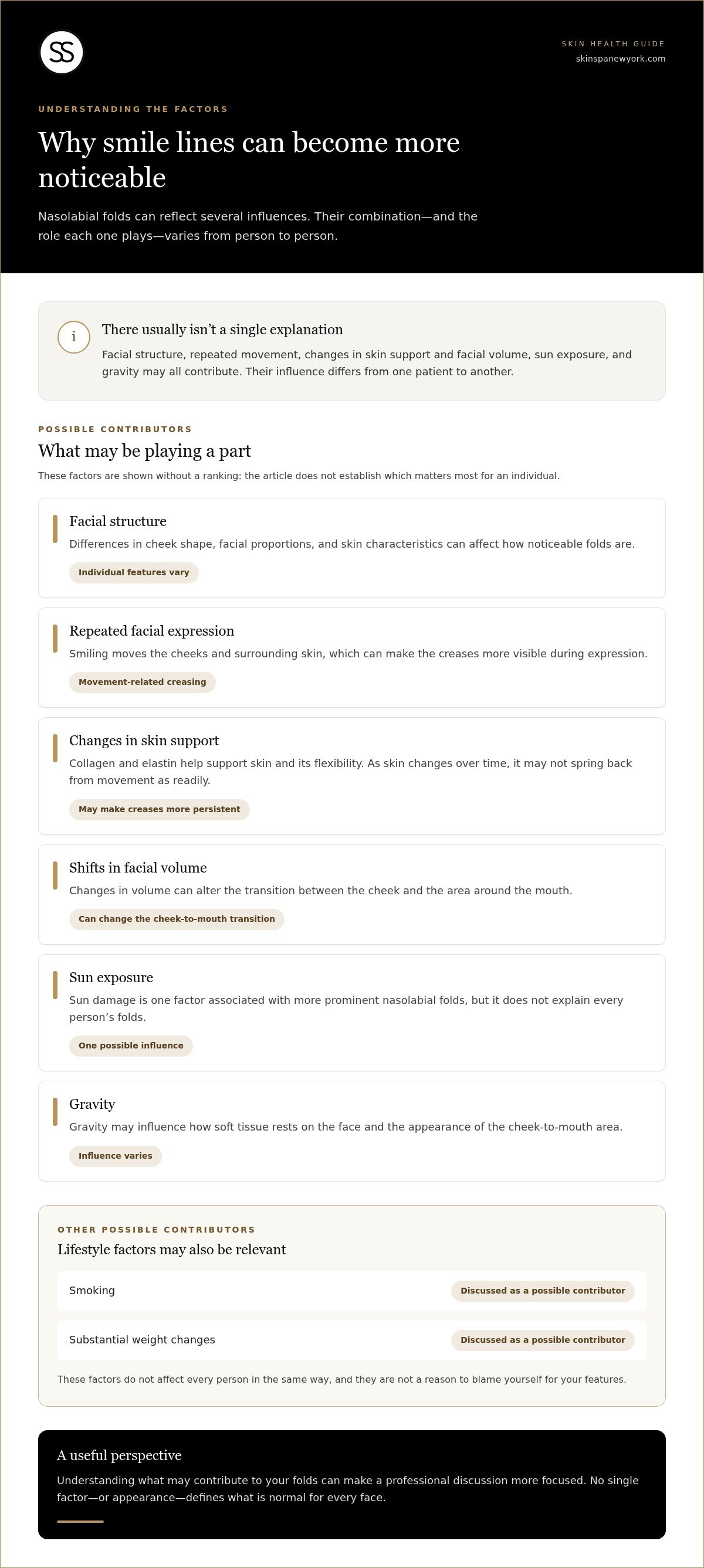
There usually isn’t a single explanation for why folds become more noticeable. Your underlying facial structure, repeated expressions, changes in skin support and facial volume, sun exposure, and gravity can all play a part. Their influence varies from person to person. These features can evolve gradually, and their appearance alone doesn’t reveal which factor matters most for you.
Collagen and elastin help give skin support and flexibility. As skin changes over time, it may not spring back from movement as readily, which can make creases more persistent. Shifts in facial volume can also alter how the cheek meets the area around the mouth. These processes may overlap rather than act as separate causes.
How Aging and Facial Structure Affect Nasolabial Folds
Natural differences in cheek shape, facial proportions, and skin characteristics help explain why folds may be noticeable in one person and subtle in another. Over time, changes in skin support and facial volume can affect the transition between the cheek and mouth area. Gravity may also influence how soft tissue rests on the face. Age alone doesn’t determine how pronounced folds become, and there’s no single age when they should appear.
For example, two people at a similar stage of life may have different fold patterns because their facial structure and changes in volume differ. Looking at what’s changing can be more useful than focusing on age or comparing your appearance with someone else’s.
Can Sun Exposure and Lifestyle Influence Their Appearance?
Sun exposure is one possible contributor to visible skin aging. Cleveland Clinic includes sun damage among the factors associated with more prominent nasolabial folds. Its effect varies, so it shouldn’t be treated as a complete explanation for an individual’s folds. Facial volume changes, repeated expression, and natural skin characteristics may also be relevant.
Smoking and substantial weight changes are also discussed as possible contributors, but they don’t affect every person or lead to the same visible changes. This isn’t a reason to blame yourself for your features. Protecting skin from excess sun and maintaining habits that support overall skin health can be worthwhile, but these steps can’t guarantee that folds won’t develop or deepen.
In short, smile lines may deepen through a combination of facial structure, repeated movement, changes in collagen and elastin, shifts in facial volume, sun exposure, and gravity. The influence of each factor differs from person to person. That combination matters when thinking about how to get rid of smile lines, because an approach suited to one contributing factor may not address another. A personalized assessment can help clarify which concerns are most relevant to your goals. Discuss your skin concerns with Skin Spa as part of considering a tailored next step.
Which Smile Line Treatments Can Help, and What Are Their Limits?
There isn’t a single cream or procedure that can erase every established fold. Different approaches target different concerns: skin care supports the skin’s surface, injectables may address movement or lost volume, and energy-based treatments focus on skin quality. Choosing among them depends on the fold’s appearance and likely contributors, your health history, and what feels right for you.
| Approach | Intended purpose | Limits and consultation considerations |
|---|---|---|
| Topical skin care | Support skin hydration, texture, and protection from sun exposure. | May help the skin look smoother, but usually won’t remove a deeper, established fold. Discuss ingredient suitability, especially if your skin is sensitive. |
| Injectables | Fillers may address volume-related folds; Botox Cosmetic may be considered when muscle movement is part of the concern. | These work differently and aren’t interchangeable. A professional can review your goals, health history, suitability, possible risks, and realistic expectations. |
| Energy-based treatments | Some approaches aim to support skin firmness or texture over time. | They don’t directly replace volume in the same way as fillers. The specific technology, treatment plan, potential risks, and recovery depend on the approach and patient. |
How Do Skincare and Professional Treatments Differ?
Skin care is supportive and ongoing. A moisturizer can help with dryness, while daily sun protection helps limit additional sun-related skin changes. Neither should be expected to lift or erase a pronounced fold. Professional treatments are selected for particular concerns. Results, risks, and recovery vary, so a personalized assessment matters before deciding what to pursue.
A useful starting point is to describe what you notice: a line that appears mostly with expression, a fold visible at rest, or changes in overall skin texture. That description doesn’t determine the treatment, but it helps focus the conversation on your priorities. If you’re curious about how to get rid of smile lines, think in terms of softening the feature you’re concerned about rather than expecting a complete reset.
Are Injectables or Skin-Rejuvenation Treatments Right for Every Patient?
No. Injectables and energy-based treatments address different concerns, and a particular option may not suit every patient. A qualified professional can review your health history, discuss expected benefits and limitations, and explain potential risks and recovery considerations before you make a decision. For more context on Botox Cosmetic, read this Botox Cosmetic treatment guide, keeping in mind that smile-line concerns require an individualized assessment.
At Skin Spa, a personalized assessment can help connect your concerns and goals with relevant options, without presenting any procedure as a guaranteed solution. Explore personalized care at Skin Spa as a step toward a considered discussion of your aesthetic goals.
What Can You Do at Home to Soften the Look of Smile Lines?
A thoughtful home routine can support skin comfort and a smoother-looking surface, but it can’t reliably reverse an established facial fold. Keep the basics simple and consistent rather than layering on products or techniques that promise dramatic change. Your skin’s needs and tolerance matter more than a complicated routine.
- Cleanse gently. Use a mild cleanser suited to your skin, and avoid vigorous scrubbing around the mouth. Pat dry rather than rubbing.
- Apply a suitable moisturizer. Choose a product that feels comfortable on your skin and use it as directed. Well-moisturized skin may look less dry or tight, though moisturizer won’t replace lost facial volume.
- Use broad-spectrum sun protection during the day. Follow the product directions for application and reapplication. Sun protection is a practical skin-health habit, not a guarantee that folds won’t form or deepen.
If you want to add an active ingredient, introduce it cautiously and follow its product directions. Start with one new product at a time so it’s easier to notice how your skin responds. If irritation persists, stop using the product and seek professional guidance, particularly if you’re unsure whether it’s appropriate for your skin.
Which Daily Habits Support Healthier-Looking Skin?
Consistency is more useful than frequent changes. A gentle cleanser, a moisturizer your skin tolerates, and daily broad-spectrum sun protection make a straightforward foundation. Keep the routine comfortable enough to maintain, and adapt it to your skin’s needs rather than copying someone else’s regimen. If a product causes ongoing redness, stinging, or discomfort, get advice instead of pushing through the reaction.
These habits support general skin health, but they don’t guarantee prevention of facial folds. If your goal is to improve the appearance of deeper creases, separate surface concerns, such as dryness or uneven texture, from folds that remain visible at rest. They can call for different approaches.
Can Facial Exercises or Creams Remove Smile Lines?
No. You shouldn’t expect facial exercises or creams to erase established folds. A moisturizer may temporarily make dry skin look more supple, and some topical ingredients may support improvements in skin texture over time. Those effects are different from changing the underlying shape or support of a facial fold. Exercises also can’t promise a lasting structural change.
Be cautious with online routines that promise to “fill” folds through repeated movements or make deep lines disappear with a single product. Results can be overstated, and a routine that irritates your skin may not be worth continuing. For realistic guidance, focus on what home care can reasonably support and seek evidence-informed advice if you’re considering a more targeted treatment. A personalized discussion can help you weigh your goals, skin tolerance, and options without pressure. Discuss your smile line concerns with Skin Spa to explore a considered next step.
How Skin Spa Personalizes Smile Line Treatment Options
Deciding what to do about smile lines can feel less overwhelming when the conversation starts with your priorities, not a predetermined procedure. Skin Spa New York’s patient-focused approach centers recommendations on each patient’s needs and goals, helping connect a concern with options worth discussing. The aim is informed decision-making, not a promise that any service will erase a fold.
During a personalized discussion, describe what you notice, when it’s most visible, and what kind of change you hope to see. Share relevant treatment history and health information, along with questions about comfort, possible downtime, risks, and aftercare. A professional can explain potential approaches and their limitations so you can consider the information before choosing whether to proceed.
What Happens During a Personalized Treatment Discussion?
The discussion should take into account your concerns, goals, relevant treatment history, and the appearance of the area. Ask how an option is intended to help, what it may not address, and what risks or aftercare considerations apply. This gives you a clearer basis for deciding whether a treatment fits your preferences, without assuming every service is suitable for every patient.
Depending on your concerns, Skin Spa New York offers Botox Cosmetic and fillers, as well as Forma Skin Tightening, Forma Accelerated, and Laser Genesis. These are distinct options, not interchangeable solutions or automatic recommendations for smile lines. Forma Skin Tightening is a facial radiofrequency treatment, with four or more sessions recommended. That guidance is not a guarantee of a particular outcome. Forma Accelerated combines laser and radiofrequency, while Laser Genesis is a redness-diffusing, collagen-boosting laser treatment. A professional can explain how these services relate, if at all, to your individual goals.
How Can Patients Take the Next Step?
Before a discussion, consider writing down your priorities. You might want to soften a fold at rest, better understand expression-related creasing, or learn about possible downtime before considering a procedure. Bringing those questions forward helps keep the conversation focused on what matters to you. You can also explore Skin Spa New York’s facial rejuvenation treatments as you consider what you’d like to discuss.
Patients can explore a personalized treatment discussion at Skin Spa New York’s New York, Boston, or Miami locations. If you’re still weighing how to get rid of smile lines, you don’t need to arrive with a decision already made. Share your concerns and questions, then take time to consider the information and possible next steps. Discuss your smile line goals with Skin Spa New York when you’re ready.
Choose a Next Step That Feels Right for You
Before deciding how to get rid of smile lines, consider what a good outcome means to you. You might prefer a subtle softening, want to understand whether treatment is worthwhile, or simply feel more confident about your skin-care choices. Being clear about your priorities can make a professional conversation more focused and help you weigh possible benefits against practical considerations such as recovery and ongoing care.
You don’t need to arrive with a treatment in mind. Skin Spa’s patient-centered approach supports an informed discussion of options that fit your concerns and goals. Take time to ask questions, understand limitations, and choose only what feels appropriate for you.
Explore personalized facial rejuvenation options at Skin Spa and take the next step at your own pace. A thoughtful plan can begin with a conversation, and you deserve to feel comfortable with the choices you make.
Frequently Asked Questions
Can smile lines appear at a young age?
Yes, smile lines can be visible in younger adults. Facial structure and the way skin folds during expression vary naturally, so their presence doesn’t indicate that you’re aging prematurely. If you’re concerned, notice whether the lines appear only when you smile or remain visible with a relaxed expression. That detail can help make a conversation about how to get rid of smile lines more specific to your concern.
Can sleeping on one side cause smile lines?
Sleeping on one side hasn’t been established as a sole cause of permanent smile lines. Pressure against a pillow may leave temporary creases when you wake, but that doesn’t mean those marks will become lasting folds. If you notice a change, look for a consistent pattern over time rather than judging from one morning. Facial structure, expression, and other factors can also influence how the area looks.
How long do smile line treatment results last?
Duration depends on the treatment and individual factors. As a general guide, botulinum toxin effects often last around three to four months, while hyaluronic acid filler results may last about six to eighteen months. These ranges aren’t guarantees, and they don’t apply to every approach. At Skin Spa, discuss the treatment being considered, what changes to expect, and when follow-up may be appropriate for your goals.
Can facial exercises get rid of smile lines?
No, facial exercises shouldn’t be expected to remove established smile lines. Repeated movements can change how the skin creases during expression, but they don’t reliably reverse a fold that remains visible at rest. If an online routine promises permanent results, treat that claim cautiously. A more useful approach is to decide whether your main concern is movement, a resting fold, or skin texture, then seek guidance based on that priority.
Are smile line treatments painful?
Comfort varies with the treatment, the area being addressed, and the individual patient. Injectable and energy-based procedures involve different sensations, so there isn’t one answer that applies to every option. Before choosing a treatment, discuss what it involves and what comfort measures may be suitable. Sharing concerns about sensitivity or previous experiences can help the professional tailor the conversation and set realistic expectations.
Can smile line treatments cause swelling or bruising?
Some procedures may involve temporary effects such as tenderness, swelling, or bruising, particularly treatments that use injections. The likelihood and duration vary by procedure and patient, and not every person experiences the same effects. Ask about possible reactions and any aftercare instructions relevant to the option being discussed. If an unexpected or concerning reaction occurs after treatment, follow the guidance provided by your treating professional.
Are smile lines the same as marionette lines?
No. They’re nearby but refer to different creases. Smile lines follow the area between the cheeks and mouth, while marionette lines extend downward from the corners of the mouth toward the chin. Knowing which area concerns you can make a treatment discussion clearer, especially if both are visible. A professional can assess the specific pattern rather than assuming that an approach for one area will address the other.
