

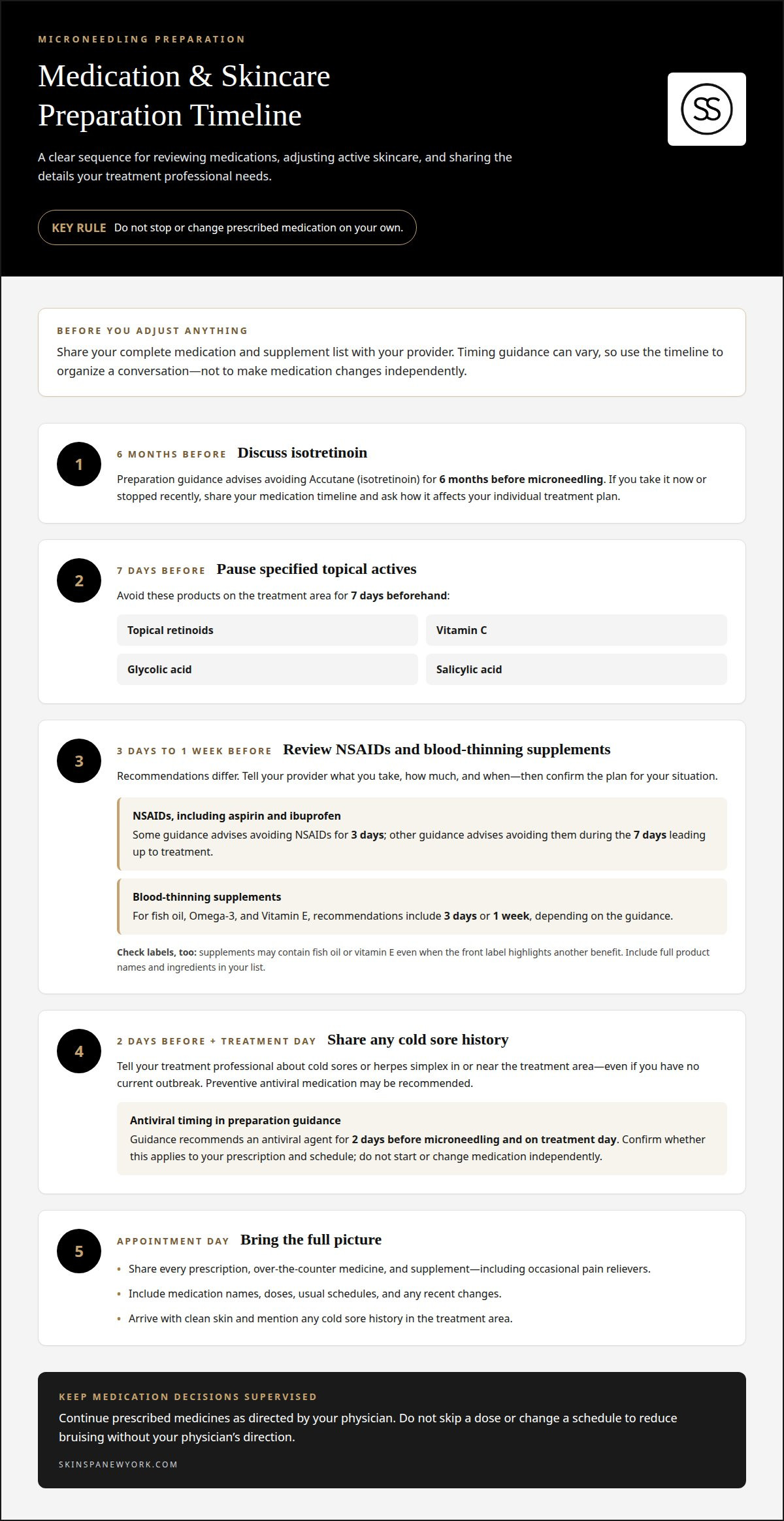
The details you leave out of your routine can matter as much as the appointment itself. To understand what not to do before a microneedling appointment, avoid topical retinoids, vitamin C, glycolic acid, and salicylic acid on the treatment area for 7 days beforehand. Don’t stop prescribed medication on your own; keep taking it as directed by your physician and share your full medication list with your provider.
It’s understandable to feel unsure about which products or medications could affect your skin, especially if you use active ingredients or are planning other treatments. A little advance planning can help you arrive with skin that’s ready for care.
This guide explains how to plan around medications and other skin procedures, what to adjust in your skincare and hair-removal routine, and how to prepare on appointment day. You’ll also find practical guidance on sun exposure to make preparation feel clear and manageable.
Key Takeaways
- Review your medications and supplements before treatment, and don’t stop prescribed medication without direction from your physician.
- Share a history of cold sores in the treatment area, since preventive antiviral medication may be recommended.
- Plan microneedling around recent or upcoming skin procedures to give your skin time between treatments.
- Adjust active skincare products and hair removal in advance, and arrive with clean skin.
- Protect your skin from sun exposure and tanning before your appointment, and reschedule if your skin is sunburned.
NSAIDs and blood-thinning medications or supplements
Discuss every medication and supplement you take, including aspirin, ibuprofen, fish oil, Omega-3, and Vitamin E. Before microneedling, avoid unnecessary blood-thinning agents, but don’t stop prescribed medication without direction from your physician.
-
Review Blood-Thinning Medications and Supplements
Make a complete list of prescription medicines, over-the-counter drugs, and supplements before your appointment. Include aspirin, ibuprofen, Motrin, Advil, fish oil, Omega-3, and Vitamin E. Timing recommendations vary: some advise avoiding NSAIDs for 3 days, while others advise avoiding them during the seven days leading up to treatment. Ask about your own medication plan before changing anything.
-
Consider Bruising Risk from Blood Thinners
Tell your provider about any blood-thinning medication or supplement, even if you take it only occasionally. These agents may increase bruising risk during microneedling. Aspirin, fish oil, Omega-3, and Vitamin E are commonly flagged. Some preparation guidance recommends avoiding them for 1 week, while other guidance gives 3 days for blood-thinning supplements. Share the exact product and timing.
- Separate prescribed medication from optional products. Don’t stop prescribed aspirin or another medication on your own. Continue taking prescribed medicines as directed by your physician, and discuss microneedling preparation with your treatment professional. This is especially important if a medication manages an ongoing condition. Bring the medication name, dose, and usual schedule so you can discuss it clearly.
- Check ingredient labels for items you might overlook. A supplement may contain fish oil or vitamin E even if its front label highlights another benefit. Write down the full product name and ingredients, then share the list before treatment. Include pain relievers such as ibuprofen, Motrin, or Advil, whether you take them regularly or only as needed.
- Use the appointment timeline to organize questions, not to make medication changes independently. Guidance may advise avoiding ibuprofen, Motrin, or Advil for 3 days before treatment, or during the seven days before the appointment. For aspirin, fish oil, Omega-3, and Vitamin E, recommendations include 1 week or 3 days, depending on the guidance. Clarify the plan for your case.
Blood-thinning medications prescribed for a medical reason require particular care. Don’t skip a dose or change your schedule to reduce bruising without your physician’s direction. Your medication history, supplement ingredients, and timing all matter when planning treatment. A thoughtful review is a key part of what not to do before a microneedling appointment: don’t make medication decisions on your own.
Herpes simplex history and antiviral medication
Tell your treatment professional about cold sores, herpes simplex, and all medications you take. A history of cold sores in the treatment area matters because preventive antiviral medication may be required.
- Share any history of herpes simplex before scheduling microneedling. Mention cold sores on or near the planned treatment area, even if you haven’t had an outbreak recently. This helps the professional plan around your history and discuss preventive antiviral medication. Don’t omit an earlier episode just because your skin looks clear on appointment day.
- Discuss antiviral timing if you’re prone to cold sores. Preparation guidance recommends taking an antiviral agent for 2 days before microneedling and on the day of treatment. A provider may recommend preventive antiviral medication for patients with a cold sore history. Ask how that plan applies to your prescription and schedule, rather than starting or changing medication independently.
- List every prescription and over-the-counter medication, including retinoids and medicines you take occasionally. Some medications can be photosensitizing, meaning they may affect how your skin responds to light exposure. Include each medication’s name, dose, and frequency. Share the list before treatment so your complete medication history can be considered.
- Discuss isotretinoin, commonly known by the brand name Accutane, before planning treatment. Preparation guidance advises avoiding Accutane for 6 months before microneedling. If you currently take it or stopped recently, give the provider the medication timeline. Don’t rely on a general retinoid rule to decide whether isotretinoin affects your individual treatment plan.
- Keep medication questions separate from skincare adjustments. Topical retinoids and other active products may have their own preparation instructions, while oral medications need to be reviewed by name and purpose. Bring a written list of medications and supplements, and identify anything prescribed for cold sores. This helps prevent missed details in a brief appointment conversation.
- Keep prescribed medicines on their existing schedule unless the prescribing physician directs otherwise. In particular, don’t skip an antiviral dose or alter another prescription to prepare for microneedling. If you’re prone to cold sores, make sure the preventive plan accounts for both the 2 days before treatment and treatment day. Share any new symptoms or medication changes before your appointment.
Spacing microneedling around other skin procedures
For professional microneedling, share recent and planned skin procedures so the treatment schedule can account for them. At-home devices have their own instructions, so don’t assume professional treatment intervals apply.
- List procedures from the past month and anything you’re planning next. Mention laser treatments, IPL, chemical peels, waxing, and other skin rejuvenation procedures. Guidance advises avoiding IPL and laser treatments for two weeks before microneedling; chemical peels are also commonly spaced two weeks beforehand. Other preparation guidance advises avoiding chemical peels, laser treatments, and waxing within one week of the appointment.
- Plan Botox timing as part of the same schedule. Botox can be performed 2 weeks before or 2 weeks after microneedling. Share the dates of recent or planned injections, along with other procedures, so your treatment timeline reflects the full sequence rather than one appointment in isolation.
- Discuss skin conditions before confirming treatment timing. Tell the professional about active acne, rosacea, eczema, a history of cold sores, pregnancy or breastfeeding, and any history of keloid scarring. These details provide important context about your skin and medical history before microneedling.
- Keep your skin hydrated and moisturized before the appointment. Use your usual gentle moisturizer and drink water as part of your routine. Don’t add unfamiliar topical products just to prepare, especially if your skin is already irritated or reacting to another treatment.
- Restart regular skincare products only when your skin is no longer irritated. Retin-A and other usual products are typically restarted on days 5-7 after microneedling. If redness or irritation remains, don’t treat the calendar as a reason to resume actives; follow the treatment instructions for your skin.
- Distinguish professional care from at-home device use. Professional microneedling planning can account for your procedure history, skin conditions, and treatment timing. At-home devices may have different instructions, so don’t copy professional spacing recommendations or combine devices and procedures without considering their specific directions.
A simple calendar of procedures, topical products, and skin reactions can make planning easier. Note the dates of chemical peels, laser or IPL treatments, Botox, and waxing, then bring the timeline to your appointment. This can flag potential conflicts before treatment day and support a more considered schedule for your skin.
For professional microneedling, share your recent and planned procedures, skin conditions, and treatment timeline so the professional can plan around them. For at-home devices, follow their specific instructions instead of assuming professional treatment intervals apply.
Preparing skin and clothing for the appointment
- Pause active skincare on the treatment area according to its ingredient. Stop topical retinoids, vitamin C, glycolic acid, and salicylic acid for 7 days before microneedling. These products can increase skin sensitivity, so check labels for ingredients as well as product names. If a topical agent causes irritation, include it in your preparation discussion instead of applying it right up to treatment day.
- Set aside other potentially irritating topical agents for 5-7 days before treatment. Avoid physical exfoliation before microneedling, including scrubs or exfoliating tools, because added friction may irritate the skin. Keep your routine simple during this period. Don’t introduce a new peel, scrub, or active serum while trying to prepare the treatment area.
- Plan hair removal around the area being treated. Avoid waxing, depilatory creams, and electrolysis on that area for 5-7 days before microneedling. Shaving during the week before the appointment is acceptable, but don’t shave on treatment day. For example, if your appointment is tomorrow, leave the razor aside and arrive without newly irritated skin.
- Arrive with clean skin on the day of treatment. Remove lotion, oil, makeup, powder, perfume, and sunscreen from the treatment area. If sunscreen is part of your morning routine, cleanse it off before the appointment rather than arriving with product on your skin. Follow any specific cleansing instructions for your treatment.
- Choose clothing that makes the treatment area easy to access. For facial microneedling, wear a comfortable top that’s easy to change out of, so you don’t have to pull tight fabric across your face. Keep jewelry and accessories simple so they don’t interfere with preparing the area.
- Before leaving home, use a quick checklist: clean treatment area, no makeup, no lotion, and no perfume. Check for irritation after removing products. If you’ve applied vitamin C or sunscreen, cleanse the skin rather than layering on more products. Bring your skincare list if you’re unsure which ingredients you paused.
- Keep the routine steady in the days leading up to your appointment. Avoid scrubs, waxing, and unfamiliar products, and follow the 7-day pause for retinoids and exfoliating acids. A clear routine makes it easier to identify what touched the treatment area. On appointment day, clean skin and practical clothing are the final preparation steps.
Should you avoid sun exposure and tanning before microneedling, and for how long?
- Protect treated skin from unprotected sun exposure for 2 weeks before microneedling. Avoiding sunburn and recent tanning is also advised during this period. Sun exposure can leave skin visibly irritated, making it important to note any time spent outdoors before your appointment.
- Use an unexpired, broad-spectrum sunscreen with at least SPF 30 during the week leading up to treatment. Apply it as directed on the label, and reapply when needed during outdoor exposure. Sunscreen helps protect against sunburn, but it doesn’t make intentional tanning or prolonged unprotected exposure a suitable preparation choice.
- Limit direct sun exposure for 2-4 weeks before microneedling. Recommendations vary on the length of this avoidance period, so record when you were last in direct sun and share that timing. Avoiding a fresh tan or sunburn is particularly important when planning the appointment.
- Skip tanning for at least 1 week before the appointment. This includes deliberate outdoor tanning and sunless tanner on the treatment area. Patients cannot be treated if they have sunburn, recently tanned, or have sunless tanner on their skin, so don’t try to conceal a tan before assessment.
- Plan outdoor activities with the sun’s strongest hours in mind. Preparation guidance advises avoiding outdoor sun exposure between 10 a.m. and 4 p.m. during the week before treatment. Choose shade or indoor plans when possible, and use broad-spectrum SPF 30 sunscreen when you need to be outside.
- Review recent IPL or laser procedures alongside your sun exposure. Avoid IPL or laser procedures, unprotected sun exposure, and sunburn for 2 weeks before microneedling. If you had a laser appointment during that period, include its date when discussing your schedule and skin condition before treatment.
- Check your skin before leaving for the appointment. Look for redness or signs of sunburn, and be prepared to describe any recent tanning or sunless-tanner use. If you’re planning microneedling, plan your microneedling treatment with sun protection and appointment timing in mind.
Preparation also involves medication and skin care: avoid unnecessary blood-thinning medications such as NSAIDs like ibuprofen, but continue prescribed medications as directed by your primary physician. Do not shave on the day of microneedling. After treatment, avoid skin-exfoliating treatments such as facials, extractions, waxing, and threading for 14 days.
Skin Spa New York: Laser Hair Removal
Skin Spa New York offers professional microneedling for skin rejuvenation. Share your medications, skincare routine, and recent procedures when discussing preparation. If you’re also planning Laser Hair Removal, include it in your treatment schedule: guidance advises waiting until eight days after microneedling before laser hair removal.
Share your skincare routine and procedure timeline when discussing microneedling, especially if you’re coordinating it with hair removal or another skin treatment. This makes it easier to plan the order of treatments and arrive prepared, rather than adjusting plans at the last moment.
For a personalized discussion about microneedling or Laser Hair Removal, contact Skin Spa New York.
Plan Your Next Step With Confidence
Preparing for microneedling is also a chance to consider how each treatment fits your skin goals. Keep a clear record of medications, skincare changes, and recent procedures, then share that context during your treatment discussion. Knowing what not to do before a microneedling appointment can help you make thoughtful decisions without changing medication on your own.
Skin Spa New York offers microneedling, Laser Hair Removal, and Customized Facial treatments in New York, Boston, and Miami. If you’re considering a broader approach to skin rejuvenation, a Customized Facial may also fit into a conversation about your priorities. Discuss what you hope to address and how treatment planning can reflect your needs.
Contact Skin Spa New York to discuss your treatment goals and take a considered next step toward personalized care.
Frequently Asked Questions
What Should You Avoid Before and After Microneedling?
Avoid last-minute changes to your medication or skincare routine, and don’t combine treatments without considering their timing. After microneedling, plan around the aftercare instructions rather than assuming you can immediately return to every usual activity. If you have an outdoor event or strenuous workout planned, consider whether it fits your recovery plan before booking. Leave enough flexibility in your schedule to follow the care instructions for your treatment.
What should you avoid before a microneedling appointment?
Avoid making several skincare changes at once, which can make it harder to identify what irritates your skin. Keep a simple record of product changes, medication updates, and recent treatments. If you’re wondering what not to do before a microneedling appointment, don’t rely on memory alone: a written timeline gives the treatment professional clear, useful context.
How long before microneedling should you stop retinoids and exfoliating acids?
Follow the product-specific pause periods described in this guide rather than applying one timeline to every active ingredient. Check labels for retinoids and exfoliating acids, including combination formulas, and note when you last used each product. If a product is prescription-strength, don’t change how you use it on your own. Bring the product name or label information to your appointment for an accurate discussion.
Can you get microneedling if you have active acne, a cold sore, or a skin infection?
Discuss an active flare or infection before treatment rather than assuming the appointment should proceed as planned. Tell the treatment professional what symptoms you have, where they appear, and when they began. If you have a cold sore, say whether it’s active or part of your past history. Clear details help the professional assess your skin and plan the next step.
Can you wear makeup or apply skincare products on the day of microneedling?
Arrive without makeup or leave-on skincare on the treatment area. If you’ve already applied a product, tell the treatment professional what it was and when you used it. Don’t try to remove residue by scrubbing vigorously, which could further irritate your skin. Have product names or packaging details ready if you’re unsure whether an item is part of your usual routine.
Should you shave or wax the treatment area before microneedling?
Avoid last-minute hair removal on the treatment area, and don’t wax immediately before your appointment. Earlier in this article, the preparation guidance explains timing for shaving and other hair-removal methods. If grooming leaves redness or discomfort, mention it instead of covering it with makeup. Sharing the method and timing gives the treatment professional a clearer picture of the area’s condition.
What medical conditions or skin treatments can make microneedling unsafe?
Microneedling planning should account for your current skin condition, medical history, medications, healing patterns, and recent treatments. Prepare a brief timeline instead of relying on memory: note active symptoms, medication changes, previous skin reactions, and procedure dates. Patients in New York, Boston, and Miami can bring that record to their appointment. This context helps the treatment professional consider your individual circumstances before planning care.
