

What if choosing a body treatment starts with the change you want, not the device name? Comparing non-surgical body contouring options NYC can feel complicated when treatments are described in different ways, especially if you’re deciding whether your priority is localized fat, muscle definition, cellulite, or firmer-looking skin.
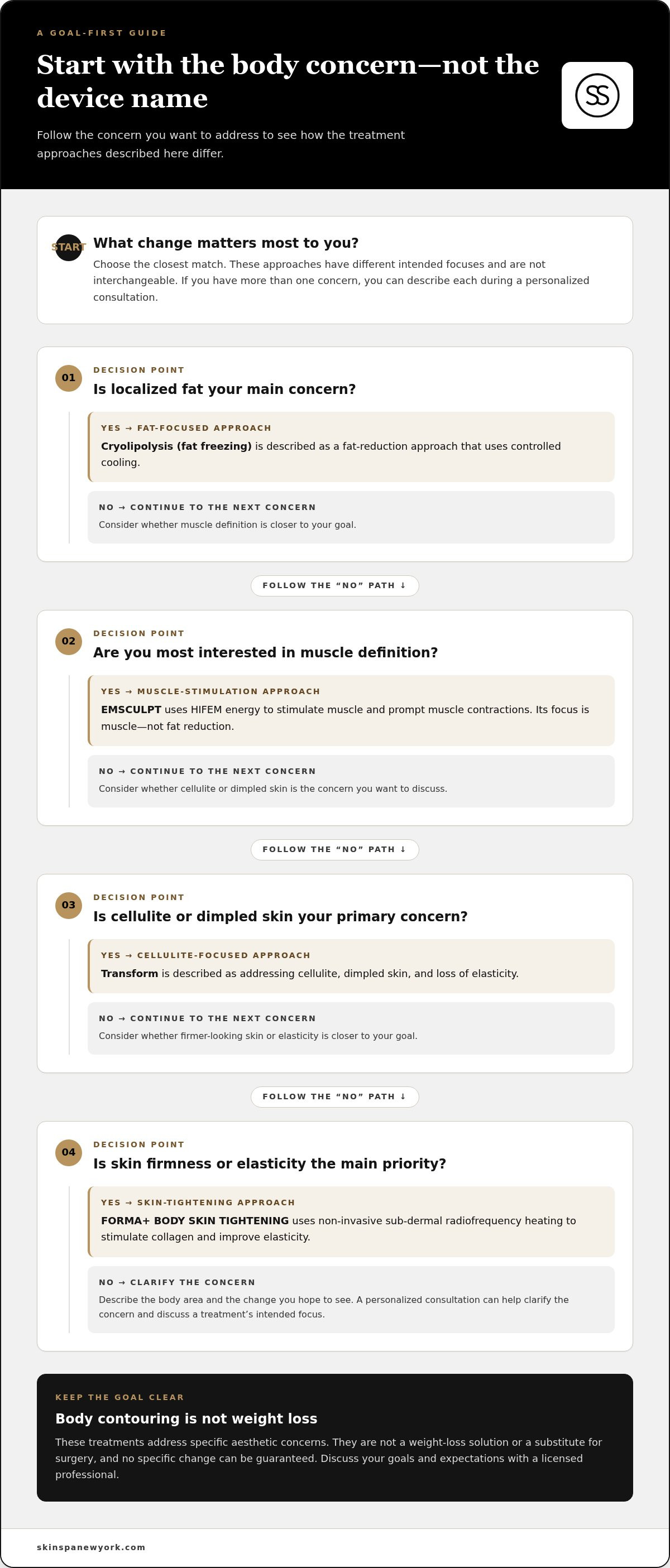
The distinction matters. EMSCULPT uses HIFEM energy to stimulate muscle, while FORMA+ BODY SKIN TIGHTENING uses radiofrequency heating to stimulate collagen and improve elasticity. Transform focuses on concerns such as cellulite, dimpled skin, and loss of elasticity. These approaches aren’t interchangeable, and body contouring isn’t a substitute for weight loss.
This guide explains how the main treatment approaches differ and how to connect your concern with a modality that may suit your goals. You’ll also find practical ways to prepare for a personalized consultation, including how to describe the area you want to address and the change you hope to see. Skin Spa New York serves patients across the city, and the goal is the same: a clearer, more informed conversation about your needs.
Key Takeaways
- Start by defining the concern you want to address, such as localized fat, muscle tone, cellulite, or skin firmness.
- Compare non-surgical body contouring options NYC by their treatment focus, not by device name alone.
- Describe the body area and the change you hope to see in your own words to give your consultation a clear starting point.
- Skin Spa offers body sculpting options with different documented focuses. Discuss how each may relate to your goals as a patient.
- Approach non-surgical contouring as a way to address specific aesthetic concerns, not as a replacement for weight loss.
What Non-Surgical Body Contouring in NYC Can, and Cannot, Address
“Which concern do I want to address?” is a useful first question for a patient considering body contouring in NYC. The term describes a category of aesthetic treatments, not a single procedure or technology. Approaches have different goals, so a device name alone doesn’t explain what a treatment is intended to address or whether it may suit an individual patient.
Body contouring is best understood by its intended treatment goal, not by the device name. Start by identifying the change you hope to see, then discuss whether a treatment approach aligns with that goal. This makes it easier to compare options without assuming that they are interchangeable.
Which concerns can body-contouring treatments target?
Patients may be interested in localized fat, muscle definition, the appearance of cellulite, or skin laxity. These are distinct concerns. Someone hoping for firmer-looking skin may have a different priority from someone interested in muscle definition. You can bring more than one concern to a consultation, but that alone doesn’t determine which treatment or combination of approaches is appropriate.
Some methods focus on a particular type of concern. For example, Cryolipolysis (Fat Freezing) is a fat-reduction approach that uses controlled cooling. Other technologies focus on muscle stimulation or skin firmness. Knowing these broad differences helps patients compare non-surgical body contouring options NYC by purpose rather than by marketing language.
Is body contouring the same as weight loss?
No. Body contouring addresses specific aesthetic concerns; it isn’t a weight-loss solution or a substitute for surgery. It’s important to distinguish a request to address a particular area or skin concern from a broader goal involving body weight.
Expectations matter, too. A treatment may be designed to address a particular concern, but it can’t guarantee a specific change or meet every patient’s goals. If you’re unsure whether your priority is fat reduction, muscle definition, cellulite, or skin laxity, describe what you’d like to see differently in your own words. A personalized consultation can clarify the concern, explain a treatment’s intended focus, and discuss whether the approach fits your expectations. That’s a practical step toward making an informed choice, without assuming that a device name or general promise tells the whole story.
How Non-Surgical Body Contouring Technologies Differ
Once you’ve named your primary concern, consider what each approach is designed to address. Some treatments focus on localized fat, while others emphasize muscle stimulation, cellulite, or skin firmness. A technology’s name or headline feature doesn’t establish whether it’s suitable for you. The treatment goal, area of concern, and individual assessment all matter.
These categories can overlap in a treatment plan, but their aims aren’t interchangeable. A patient seeking more visible muscle definition is asking a different question from someone hoping to improve skin elasticity. Keeping the intended focus in view makes non-surgical body contouring options NYC easier to compare.
Fat-focused approaches versus muscle stimulation
Fat-focused treatments are intended to address localized fat, while muscle-stimulation approaches focus on activating muscle. Cryolipolysis and other non-surgical fat-reduction methods use different approaches to target fat. The American Society of Plastic Surgeons offers an overview in its guide to Understanding Non-Surgical Fat Reduction.
EMSCULPT uses HIFEM energy to stimulate muscle. In plain terms, the approach prompts muscle contractions. That focus may interest a patient seeking muscle definition, but it shouldn’t be confused with a fat-reduction goal. Before discussing either approach, clarify what change you want and which area you hope to address.
Radiofrequency, cellulite, and skin-firming approaches
Radiofrequency, or RF, is used in some treatments focused on skin firmness. FORMA+ BODY SKIN TIGHTENING uses non-invasive sub-dermal heating to stimulate collagen and improve elasticity. Its documented focus is different from muscle stimulation, even though both approaches may be discussed under the broad category of body contouring.
Muscle stimulation focuses on muscle tone; skin-tightening approaches focus on firmness and elasticity. Cellulite is another distinct concern, often described as dimpled skin. Transform is described as a treatment for cellulite, dimpled skin, and loss of elasticity. These concerns can occur alongside localized fat, but they aren’t identical. Don’t assume a treatment’s focus from its name alone.
When comparing options, look for a clear explanation of the intended goal and how it relates to your concern. If you’re weighing skin firmness against muscle definition, or cellulite against localized fat, a personalized discussion can help clarify your priorities. Skin Spa’s body-contouring treatments are available to discuss with the team. Discuss your body-contouring goals.
How to Compare Body Contouring Options for Your Goal
A useful comparison starts with the concern you want to discuss, not an assumption that every non-surgical treatment works the same way. “Non-surgical” describes a broad category, not a shared mechanism or a promise of identical results. Some approaches focus on localized fat, others on muscle stimulation, cellulite, or skin firmness. A treatment name alone can’t tell you whether it fits your goals or the area you want to address.
Match the treatment focus to the concern
Use the table to organize your questions before a consultation. It’s a starting point for discussion, not a ranking of treatments or a recommendation for every patient.
| Concern | Approach to discuss | Consultation question |
|---|---|---|
| Localized fat | A fat-focused body-contouring approach intended to address a specific area. | Is this approach designed for the area and concern I’m describing? |
| Muscle definition | A muscle-stimulation approach. EMSCULPT uses HIFEM energy to stimulate muscle. | Does the treatment focus align with my goal for muscle definition? |
| Cellulite or dimpled skin | A cellulite-focused treatment option, such as Transform. | How does the treatment address the skin concern I’ve identified? |
| Skin firmness or elasticity | A skin-tightening approach. FORMA+ BODY SKIN TIGHTENING uses non-invasive sub-dermal heating to stimulate collagen and improve elasticity. | Is skin firmness the primary focus of this approach? |
Each row points to a different treatment goal, not a guaranteed result. A patient interested in muscle definition can discuss a muscle-stimulation approach, while someone concerned about skin firmness can ask about skin-focused options. For fat-related goals, keep the conversation centered on the treatment’s intended focus and the specific area, without assuming that fat reduction is assured.
What the comparison cannot decide on its own
A table can make unfamiliar terms easier to compare, but it can’t determine which approach is suitable for an individual patient. That depends on the patient’s goals and a professional assessment of the concern and area being discussed. A device or treatment name shouldn’t be taken as proof that it addresses every area or concern in the same way.
Bring your priorities into the conversation in plain language. You might say, “I’m most interested in firmer-looking skin,” or “I’d like to discuss muscle definition in this area.” If more than one concern matters, explain which is most important. This gives a personalized consultation a clear starting point and helps distinguish what a treatment is designed to address from what you hope to achieve.
As you compare non-surgical body contouring options NYC, ask for a clear explanation of the treatment focus and how it relates to your goals. An informed decision comes from understanding the approach, not choosing the most familiar device name.
How to Prepare for a Body Contouring Consultation in NYC
A focused consultation begins with your priorities, not a device name. Before discussing treatments, consider what you hope to change, which area concerns you, and what you want to understand. You don’t need technical terms. Your own description gives the licensed professional a useful starting point for discussing options and personalizing care.
- Name the concern. Decide whether you’re most interested in localized fat, muscle definition, cellulite, or skin firmness. If several matter, identify the one you’d like to discuss first.
- Describe the area. Explain where you’d like a change in your own words. Being specific can help keep the conversation centered on your concern.
- Share relevant history. Mention any prior body treatments that may help explain your experience or preferences. You can also describe what you liked or found unclear about those treatments.
- Write down your questions. Ask what the proposed technique is intended to address, how it relates to your goal, and how the plan is personalized for you.
Bring clear goals and questions
A patient seeking greater muscle definition may want to ask about a muscle-stimulation approach, while someone focused on cellulite or firmer-looking skin may want to discuss skin-focused options. If your goal is fat-related, explain the area and ask about the treatment’s intended focus without assuming a particular outcome. Clear questions make it easier to understand why an approach is being discussed and whether it aligns with your priorities.
Discuss expectations and treatment details
Ask the licensed professional to explain the technique in accessible terms, the concern it is intended to address, and how the proposed plan reflects your goals. Share what you hope to see and any uncertainties you have. Treatment expectations are personal, and an open conversation can help distinguish the intended purpose of an approach from an outcome that can’t be promised.
You can also ask what informs the treatment recommendation and whether the plan addresses one concern or more than one. Skin Spa’s patient-right-to-know policy advises each patient on the products and techniques best suited to maximize the benefits of their service. You should feel comfortable understanding the technique being discussed and its intended purpose before deciding how to proceed. If an explanation feels too technical, ask for it to be restated in plain language.
As you prepare for a consultation, explore Skin Spa’s body treatment options and note any names or questions you’d like to bring into the discussion. Skin Spa serves patients in New York, Boston, and Miami. Wherever you visit, connect the option under consideration with your stated concern rather than choosing based on a device name alone.
Skin Spa’s Non-Surgical Body Contouring Options in NYC
Skin Spa offers several body-contouring treatments to discuss in a personalized consultation. Their names represent different options, not automatic recommendations. Start with your concern, the area you’d like to address, and the treatment’s documented focus. The options below can help you prepare questions and understand how each treatment may relate to your goals as a patient.
Options focused on fat, muscle, and body definition
For a muscle-focused goal, EMSCULPT uses HIFEM energy to build muscle and burn fat. It is available for the abdomen, arms, buttocks, and legs. TruFlex® offers customizable muscle stimulation using Multi-Directional Stimulation (MDS) technology. These options may be relevant to discuss if muscle definition is your priority. A consultation can help clarify how the treatment focus relates to the area and change you have in mind.
TruID® is a quick, non-invasive fat-removal treatment described as permanent, with visible results. It is also described as reducing cellulite and creating tighter-looking skin. If you’re considering concerns that involve both fat and the appearance of cellulite, ask how its intended focus relates to your goals. Individual suitability and outcomes are matters to discuss in a personalized consultation.
These options shouldn’t be treated as interchangeable. If you’re comparing muscle stimulation with a fat-focused approach, explain which change matters most to you and ask the licensed professional to describe the reasoning for the treatment being discussed. Clear answers can help you understand the difference between a treatment’s stated purpose and your personal expectations.
Options focused on skin, cellulite, and a tailored plan
FORMA+ BODY SKIN TIGHTENING (RF) uses non-invasive sub-dermal heating to stimulate collagen, improve elasticity, tighten skin, and reduce wrinkles. It may be worth discussing when skin firmness is your central concern. Transform is described for cellulite, dimpled skin, and loss of elasticity, with a six-to-eight-session treatment course. Discuss how that course relates to your goals rather than assuming a specific outcome.
Evolve is a three-step body-remodeling system with distinct treatment modes: Evolve Tite for skin remodeling, Evolve Trim for fat cell elimination and skin tightening, and Evolve Tone for muscle toning and definition. BODYFX uses RF to remodel skin and reduce cellulite. These different focuses can help you organize questions, but a treatment name alone doesn’t determine suitability. Discuss your priorities with the team as part of a personalized review.
If your questions extend to skin remodeling, you can also explore Skin Spa’s Morpheus8 body contouring guide as a related resource. It can help you identify questions before discussing how your interests connect to a treatment plan.
To explore personalized body contouring at Skin Spa, review the available treatment options and bring your goals to a consultation in New York, Boston, or Miami.
Take the Next Step With a Goal in Mind
You don’t need to arrive with a treatment already chosen. Bring your priorities and questions into a conversation, then leave with a clearer understanding of which approach may align with what matters to you. A helpful discussion makes room for your individual goals without pressuring you toward a particular device or promising a specific outcome.
Skin Spa offers multiple body-contouring approaches to discuss, with a patient-right-to-know policy that emphasizes guidance on the products and techniques best suited to each patient. Share what you’d like to address and ask about the reasoning behind the options presented. That clarity can help you make a considered choice among non-surgical body contouring options NYC.
Book a personalized body-contouring consultation with Skin Spa in New York, Boston, or Miami to discuss your goals and the treatment approaches that may suit them.
Frequently Asked Questions
What is the difference between body contouring and weight loss?
They refer to different goals: body contouring focuses on a specific aesthetic concern, while weight loss focuses on a change in body weight. Before a consultation, consider what you want the discussion to help you decide. For example, you might want to understand an option for a particular area or clarify whether your expectations relate to a broader weight-related goal. Being clear about your aim can make the conversation more useful.
Can non-surgical body contouring address more than one concern?
You can discuss more than one concern, but it’s helpful to prioritize rather than assume a treatment will address them all. Write down the concerns you’d like to raise, then mark which one matters most to you. Ask how each concern would factor into a personalized recommendation. This keeps the conversation focused on your priorities and makes it easier to understand the reasoning behind a treatment plan.
How do fat-focused and muscle-stimulation treatments differ?
They are intended to address different concerns: fat-focused approaches target fat-related goals, while muscle-stimulation approaches focus on activating muscle. If you’re unsure which description fits your priority, explain the change you want in everyday language rather than trying to select a technology yourself. A licensed professional can clarify the treatment’s purpose and discuss how it relates to your concern, without treating either category as a promise of a particular result.
What body areas can EMSCULPT treat at Skin Spa?
Skin Spa offers EMSCULPT for the abdomen, arms, buttocks, and legs. Note which area you want to discuss and describe your personal goal for it. A listed area is a useful starting point, not an individual recommendation. A consultation can clarify whether the treatment’s intended focus relates to your concern and answer questions you may have before deciding on next steps.
How many Transform sessions are described for cellulite and skin elasticity concerns?
Transform is described as a course of six to eight sessions for concerns including cellulite, dimpled skin, and loss of elasticity. Treat that as a planning reference, not a promise about your individual outcome. If you’re considering this treatment, ask how the course relates to your concern and what the treatment is intended to address.
What does Evolve Tite, Trim, and Tone each focus on?
Evolve Tite focuses on skin remodeling, Evolve Trim on fat cell elimination and skin tightening, and Evolve Tone on muscle toning for definition. Use these distinctions to identify which goal you want to discuss, then ask how the mode being considered relates to your priorities. The mode names can help organize your questions, but they aren’t a substitute for an individualized assessment. You don’t need to choose a mode on your own before speaking with a licensed professional.
How should I choose a non-surgical body contouring option in NYC?
Use your own goal as the starting point, then discuss it with a licensed professional rather than diagnosing yourself from a device description. Before the visit, note the area you’re concerned about, the change you hope to explore, and any previous treatments relevant to the conversation. Skin Spa serves patients in New York, Boston, and Miami. A focused discussion can help you understand the options and decide what questions to consider next.
